

June 11, 2012

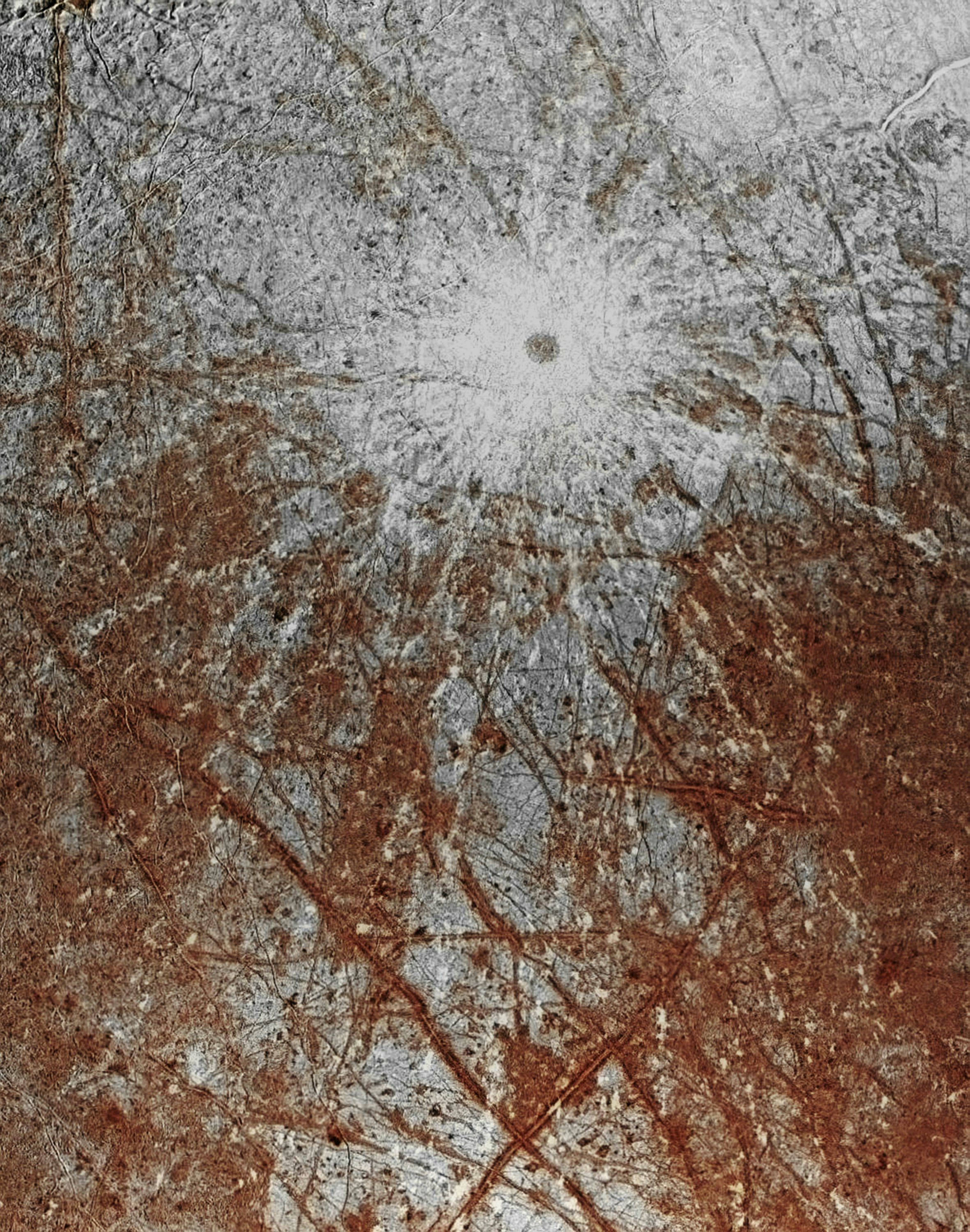
Credits: NASA/JPL/Galileo Project; Univ. of Arizona - Credits for the additional process. and color.: Dr Paolo C. Fienga/Lunar Explorer Italia/IPF
|
Today's APOD is an image of the Region surrounding the (allegedly) young Impact Crater Pwyll, which is located on the Jovian moon Europa (a Celestial Body that, as you should have noticed, has recently become a target of great interest to us as well as to our Readers - we believe because Europa, as it has been written in the past, may really host, in a "Liquid Ocean" located deep under its Icy Crust, some kind of Indigenous Lifeforms whose actual discovery, if and when it shall occur, may be totally fit to change the Human Vision of the Universe, of Life and, at the same time, may also be able to give a totally new meaning to our presence - and role, perhaps - on Planet Earth). The Region where you see the Crater Pwyll is located on the Trailing Hemisphere of Europa, at about 11° South Lat. and 276° West Long.; this image is approx. 1240 Km across, while Pwyill Crater has a diameter of approx. 26 Km "only". North is toward the bottom of the image, and the Sun illuminates the Surface of Europa from the East. The approx. 26-Km-diameter Impact Crater Pwyll, which is very well visible towards the top of the image, is thought to be one of the youngest Features located on the Surface of Europa. The diameter of the central dark spot, ejecta blasted from beneath Europa's surface, is approximately 40 kilometers, and bright white rays extend for over a thousand kilometers in all directions from the impact site. These rays cross over many different terrain types, indicating that they are younger than anything they cross. Their bright white color may indicate that they are composed of fresh, fine water ice particles, as opposed to the blue and brown tints of older materials elsewhere in the image. Also visible in this image are a number of the Dark Lineaments which are also known as "Triple Bands" (that is because they show a Bright Central Stripe surrounded by some Darker Material). Scientists, as they attempted to reconstruct the Geologic History of Europa, have used the order in which these "Bands" cross one-other so to (try to) determine the right time-sequence of their formation, as well as their relative ages (note that this method is based on the very same logic that we use, as Planetary Scientists, to find out, in the event of intersecting and/or overlapping Impact Craters, which one of them is the Youngest and which one the Oldest). Furthermore, once it has been taken into account the fact that the Surface of Europa seems to be (and, most likely, it actually is) formed by solid Water Ice (now having the consistency of an extremely hard Rocky Slate), we do believe that the criteria to be used in order to evaluate its Age, as well as the Age of its most visible and intriguing Surface Features - just like the Impact Crater Pwyll - should follow some strongly different lines of reasoning. We, as IPF, believe that this subject is way too complicated to be discussed here, but there is one thing that we are quite sure of, and that we wish to share with you all: we believe that the Impact Crater Pwyll is not young at all! On the contrary, we honestly think that Pwyll is an extremely old Impact Crater, and this - in our opinion solid - assumption can be proven once you check how the Rays departing from Pwyll itself (and which are nothing else but deep Surface Cracks that formed at the time of the impact that created Pwyll) cross the abovementioned Bands which characterize the whole Surface of Europa. This frame has been colorized in Enhanced Absolute Natural Colors (such as a slightly sharper version of the colors that a human eye would actually perceive if someone were onboard the NASA - Galileo Spacecraft and then looked outside, towards the Surface of the Jovian moon Europa), by using an original technique created - and, in time, dramatically improved - by the Lunar Explorer Italia Team. |
News visualized: 784 times