

June 10, 2012

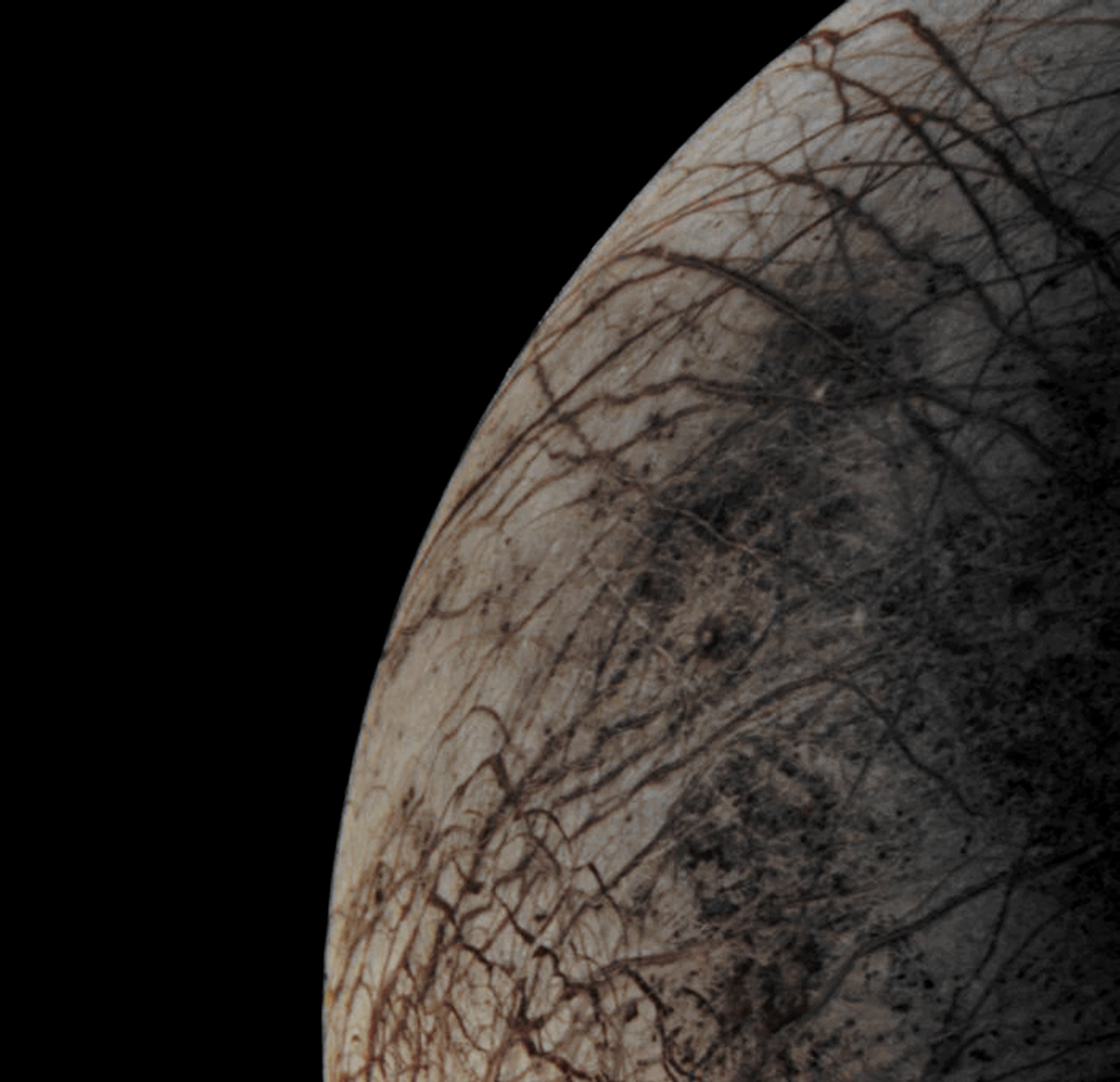
Credits: NASA/JPL/Voyager 2 Mission - Credits for the additional process. and color.: Dr Paolo C. Fienga/Lunar Explorer Italia/IPF
|
This image of the Jovian moon Europa was acquired by the NASA - Voyager 2 Spacecraft during its close encounter with this extremely mysterious and fascinating Celestial Body as it occurred on Monday morning, July 9, of the AD 1979. Europa, which is roughly the size of our Moon, is thought to have a Crust of Ice (perhaps about 100 Km thick) which overlies the Silicate Crust. The complex array of Streaks that can easily be seen in the frame, may indicate that the Crust has been first fractured, and then filled up by some sort of materials, possibly coming from the interior of the moon. The absolute lack of Relief, of any visible Mountains, or even of any Impact Crater on Europa's bright Limb, appears to be consistent with the idea of the existence of a thick Ice Crust, covering its entire Surface. In contrast to its close neighbors, Ganymede and Callistus, Europa has, in fact and once you consider, as we said before, its whole Surface, very few Impact Craters, and it does not show the existence of Hills, nor Mountains In this picture, however, one possible candidate (meaning one possible Impact Crater) is the small Surface Feature that is barely visible near the center of the image, showing some kind of Radiating Rays, a very dark (and relatively large) Outline and a bright, Circular Interior. The relative absence of those Surface Features which are typically found on Celestial Bodies such as this one, as well as the very Low Topography of Europa (meaning, in other words, that Europa seems to be a substantially "flat" world), suggest that its Crust is very young and also (likely) warm just a few kilometers below the Surface. The Tidal Heating Process (---> Tidal Friction) that has been suggested to explain the restlessness of the Jovian Volcanic moon, Io, may also be working the same way for Europa's interior, even though at a lower rate. The idea of a constantly warm inner core of Europa led, in time, to the speculation that this moon might possess, just a few tens of kilometers under its Icy Crust, a liquid Ocean. A liquid Ocean that, just like quite a few Scientists have suggested, may also contain some - perhaps exotic - Indigenous Lifeforms... This frame has been colorized in Absolute Natural Colors (such as the colors that a human eye would actually perceive if someone were onboard the NASA - Voyager 2 Spacecraft and then looked outside, towards the Limb of the Jovian moon Europa), by using an original technique created - and, in time, dramatically improved - by the Lunar Explorer Italia Team. |
News visualized: 842 times