


June 9, 2012

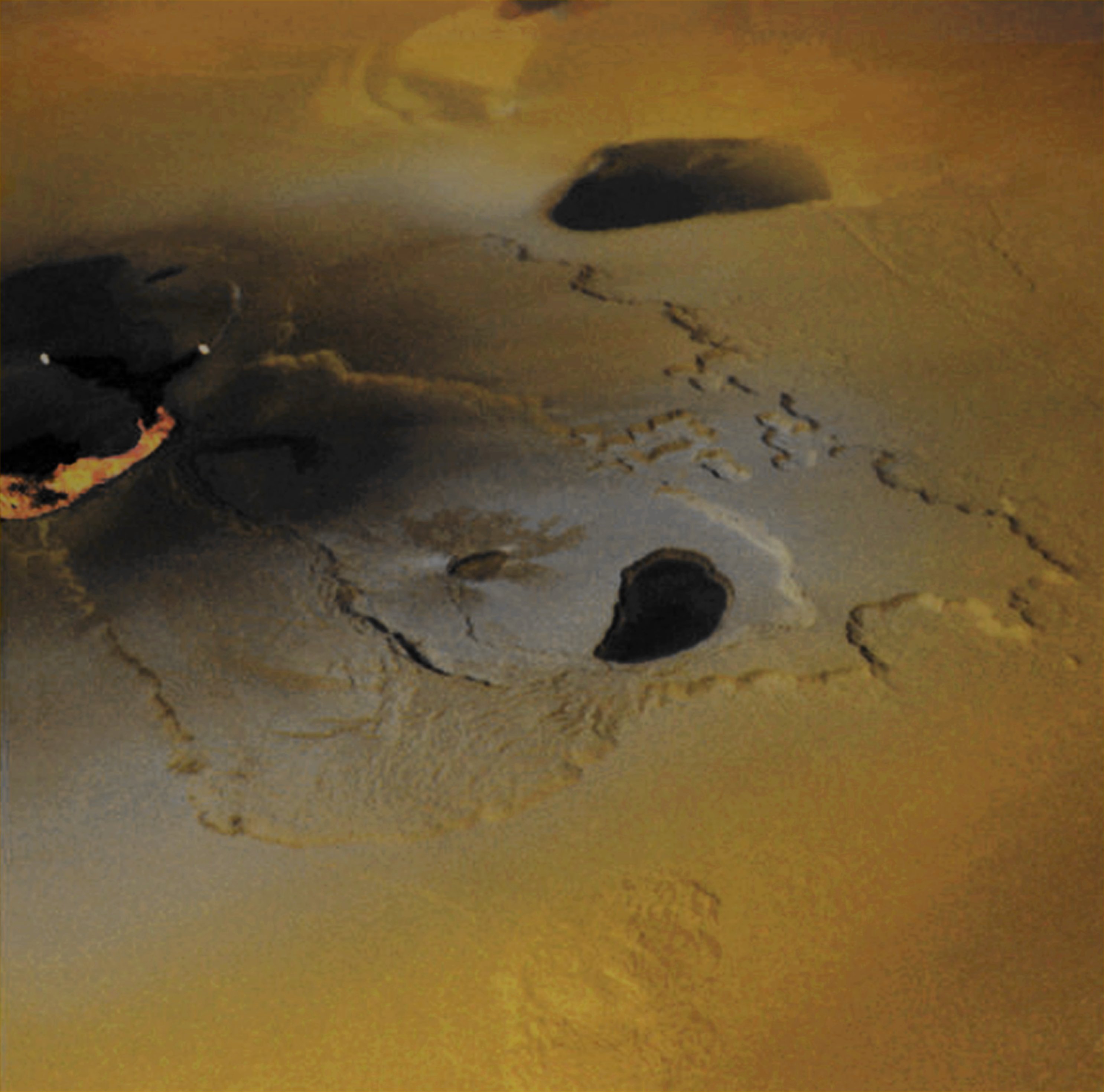
Credits: NASA/JPL/Galileo Project - Credits for the additional process. and color.: Dr Paolo C. Fienga/Lunar Explorer Italia/IPF
|
An active Volcanic Eruption on Jupiter's restless moon Io (actually, this one is just one of the VERY many Volcanic Events that occur on that small and unbelievably hyperactive far distant world) was captured in this image taken on the 22nd day of the month of February of the AD 2000 during a close Io's Fly-By from the NASA - Galileo Probe. In fact, Tvashtar Catena, such as a Chain of Giant Volcanic Calderas centered at about 60° North Lat. and 120° West Long., is the location of another Highly Energetic Eruption (----> likely an Explosive Eruption) which was caught in the action by the Galileo Spacecraft during an earlier Fly-By of the Jovian moon and, most likely, just when the Eruption started, sometime in November 1999. A dark, "L"-shaped Lava Flow to the left of the center in this more recent image, marks the location of the aforementioned November Highly Energetic Eruption. The intense yellow and orange river-like area located on the left side of the picture shows newly erupted Hot Lava, while the two small bright spots (still located on the central/upper left of the frame) are sites where Molten Rock is exposed to the Surface at the toes of the Lava Flows. The larger orange and yellow ribbon visible in the upper central portion of the picture is a cooling Lava Flow that is more than more than 60 Km (approx. 37 miles) long. Out of curiosity, the dark and grayish, diffuse Deposits of Ashes and other Volcanic Materials surrounding the Active Lava Flows, were not there during the November 1999 NASA - Galileo Probe's Fly-By of Io. This picture is about 250 Km (approx. 155 miles) across. North is toward the top and the Solar Illumination comes from the West (Sx - left). In the late February of the AD 2007, another huge eruptions from Tvashtar was recorded by the NASA - New Horizons Spacecraft (now heading towards Pluto and the Kuiper's Belt). As Dr Andy Cheng (from the Johns Hopkins' Applied Physics Lab.) said" "...We were actually hoping to catch some activity from a different Volcano: Prometheus...". Prometheus is an old Volcano on Io which has been photographed many times before by the NASA Voyager and Galileo Probes (and, as a matter of fact, Prometheus also appears in the New Horizons photo). However, what the Camera onboard the NASA - New Horizons Spacecraft actually spotted in February 2007 (and which we shall show you in a future APOD), was a gigantic "arc-shaped" Volcanic Plume from Tvashtar, which - litterally - dwarfed the Grand Old Prometheus, by rising more than 180 miles (approx. 290 km) above Io's Surface. You should consider, for comparison, that Volcanoes on Earth spew their Hot Gases and Dust just a few miles high. The patchy and somehow filamentous structure seen in the Tvashtar Plume suggests that condensation from Gas to Solid Particulates was occurring at the time of the Plume was rising in the Space over Io. This means, in other words, that the just erupted Volcanic Gases, once they reached a certain altitude and cooled off, they immediately started crystallizing in the cold Space above Io and then falling back on the small moon's Surface in the form of some kind of "Sulphurous Snow". This frame has been colorized in Absolute Natural Colors (such as the colors that a human eye would actually perceive if someone were onboard the NASA - Galileo Probe and then looked outside, towards the Tvashtar Volcano, located of the Jovian moon Io), by using an original technique created - and, in time, dramatically improved - by the Lunar Explorer Italia Team. |
News visualized: 1125 times