


June 2, 2012

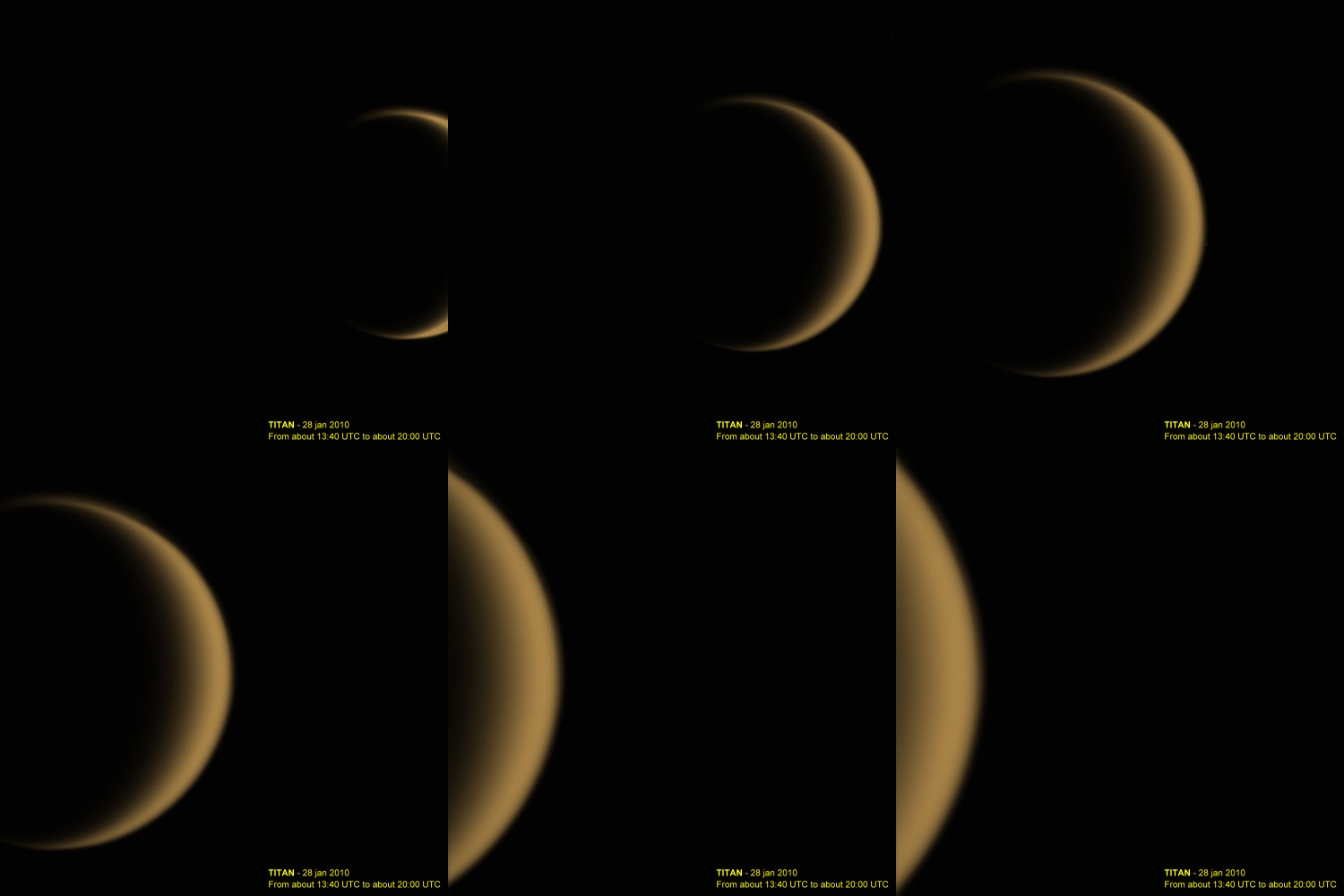
Credits: NASA/JPL/Space Science Institute - Credits for the additional process. and color.: Elisabetta Bonora/Lunar Explorer Italia/IPF
|
The Surface of Titan has been described by Planetary Scientists as "complex, fluid-processed, [and] geologically young" but, as you know, Titan’s Atmosphere, since it is twice as thick as the Earth's one, makes it difficult for astronomical instruments to image the Surface of this Saturnian fascinating moon in the Visible Light Spectrum. The NASA - Cassini Spacecraft, however, has been using each and every of its onboard Scientific Instruments (i.e. and above all the InfraRed Cameras and the Synthetic Aperture Radar - or SAR) in order to image (and then to map) as much as possible of the Surface of Titan during its close Fly-Bys. The early images of Titan revealed a diverse Geology, with both rough and smooth areas. There are a few Surface Features that seem to be Volcanic in origin and which - most likely - disgorge, instead of Lava, Mud and Water-Ice mixed with Ammonia (so-called "Cryovolcanoes"). The Synthetic Aperture Radar (SAR) located onboard the NASA - Cassini Spacecraft has also identified very usually-looking "Streaky" Surface Features (some sort of huge Sand Dunes belonging to a very large Sand Sea - or Erg -, maybe) which, in certain cases, reach several kilometers in length and - we believe - were generated by the accumulation of Windblown Particles. A deeper and more accurate examination of this intriguing Celestial Body has also shown that the Surface of Titan is relatively smooth: as a matter of fact, the few Surface Features that look like Impact Craters (but we are not sure of their actual nature) seem to have been filled in, perhaps by a Rain made of Liquid Hydrocarbons. In other cases, such (in a way) ambiguous Surface Features appear to be (conventional - and now extinct) Volcanic Calderae. The Radar Altimetry Data that we have obtained and examined so far, show (better yet: suggest) that the Height Variations on Titan are generally extremely low (and, in average, they do not reach differences of more than 150/200 meters); however, some occasional Elevation Change (in the range of approx. 500 meters) has been discovered, but no Mountains whatsoever have been seen so far. On the other hand, Titan seems to possess a few Hills that, sometime, may reach several hundreds to a little more than 1000 meters in height. Titan's Surface is marked by broad Regions of bright and dark Terrain. These include the Region known as Xanadu, such as a Large, highly reflective Equatorial Area about the size of Australia. It was first identified in InfraRed images from the Hubble Space Telescope during the AD 1994, and it was later much better viewed by the NASA - Cassini Spacecraft. This convoluted Titanian Region is characterized by the presence of many Hills and it is cut by Valleys and Chasmas. It is also criss-crossed, in places, by dark Lineaments — sinuous topographical features resembling Ridges or Crevices - and it has been suggested that these Surface Features may represent the final result of some powerful Tectonic Activity (a circumstance that, if - and when - confirmed, would indicate that Xanadu is, in fact, a geologically young Region). Alternatively, such a Lineaments may also be liquid-formed Channels, suggesting the existence of old Terrain that has been cut through by Stream Systems. The frames forming this GIF-Movie have been colorized in Natural Colors (such as the colors that a perfect human eye would actually perceive if someone were onboard the NASA - Cassini Spacecraft and then looked outside, towards the Saturnian moon Titan), by using an original technique created - and, in time, dramatically improved - by the Lunar Explorer Italia Team. |
News visualized: 766 times