


January 14, 2012

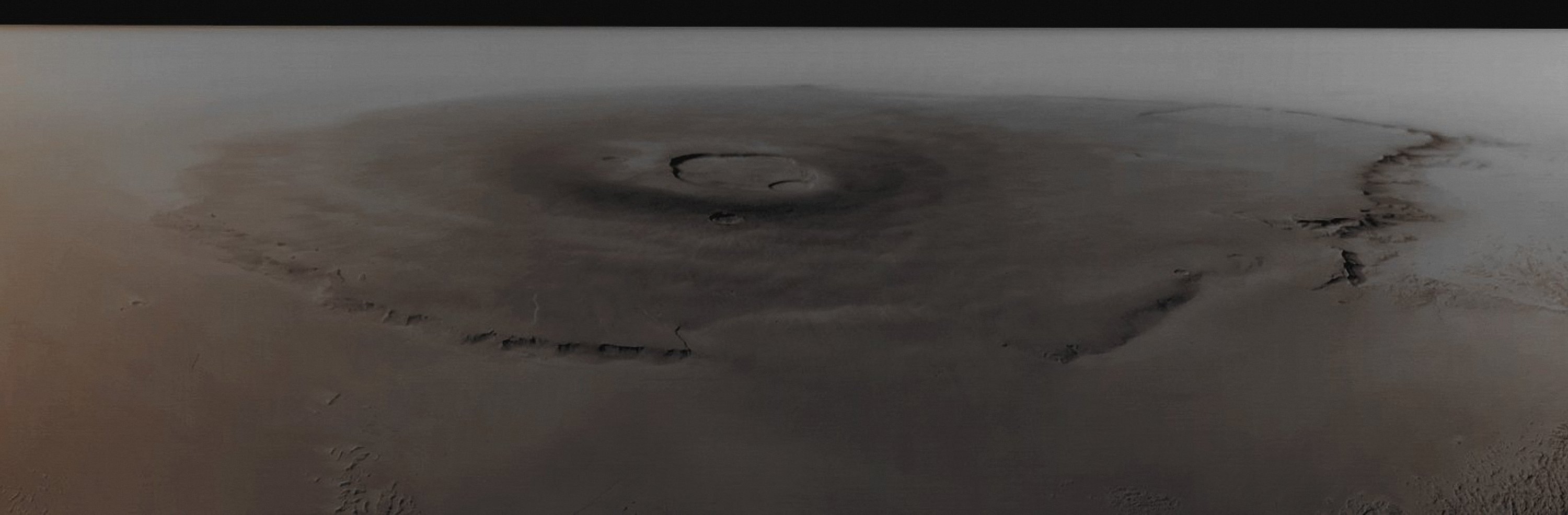
Credits: NASA/JPL/Malin Space Science Systems (MSSS) - Credits for the additional process. and color.: Dr Paolo C. Fienga/Lunar Explorer Italia/IPF
|
This is a Red Camera Wide Angle view of the Giant Martian Volcano, Olympus Mons, acquired by the NASA-Mars Global Surveyor (MGS) Orbiter - Mars Orbiter Camera (MOC). You may want to consider, for comparison, that the Olympus Mons Volcano is large enough to cover much of the American State of New Mexico. This view was taken looking West toward the Sunward Limb of the Red Planet. The Limb is the Martian Horizon as seen by the Orbiter, while the dark band visible on top of the frame is the Outer Space. In order to get a better understanding of the so-called "Illumination Geometry", you have to consider that the Sunlight illuminates this scene from the lower left. With a diameter of more than 600 Km and a height of nearly 25 Km above the surrounding Lava Plains, Olympus Mons is the tallest Volcano known to exist in the entire Solar System. When Clouds are present, Olympus Mons is sometimes even visible above them! The relative ages of the Surface in various parts of Mars can be estimated from the number of Impact Craters present in a given area, with young Regions having fewer Impact Craters than old Regions. Only a few Impact Craters are visible here, indicating that Olympus Mons is young, probably the youngest Volcanic Feature on Mars. By some estimates, the most recent Large Volcanic Eruption at Olympus Mons could have occurred "only" 25 Million Years ago, while the oldest activity at Olympus Mons could be much older than this and its evidence would have been buried by younger Lava Flows. The Caldera of Olympus Mons is the depression near the top center of the image. Said Caldera is about 65 × 80 Km across (approx. the size of the American State of Rhode Island) and occurs near the maximum elevation of the Volcano. The Caldera formed when the Magma within the Volcano either erupted out of Vents located on the side, or temporarily drained deeper into the Planet. In either case, the removal of this Magma allowed part of the overlying Surface to collapse (---> meaning to fall on itself, due to its own extreme weight), producing a Topographic Depression that is termed as "Caldera". The overlapping series of structures in the Olympus Mons Caldera demonstrates that this Magma withdrawal occurred a number of different times. Similar Calderas, however, can be seen on several other Volcanoes, both on Mars and on Earth. This frame has been colorized in Absolute Natural Colors (such as the colors that a human eye would actually perceive if someone were onboard the NASA - Mars Global Surveyor Orbiter and then looked down, towards the Surface of Mars), by using an original technique created - and, in time, dramatically improved - by the Lunar Explorer Italia Team. |
News visualized: 1203 times