

May 23, 2012

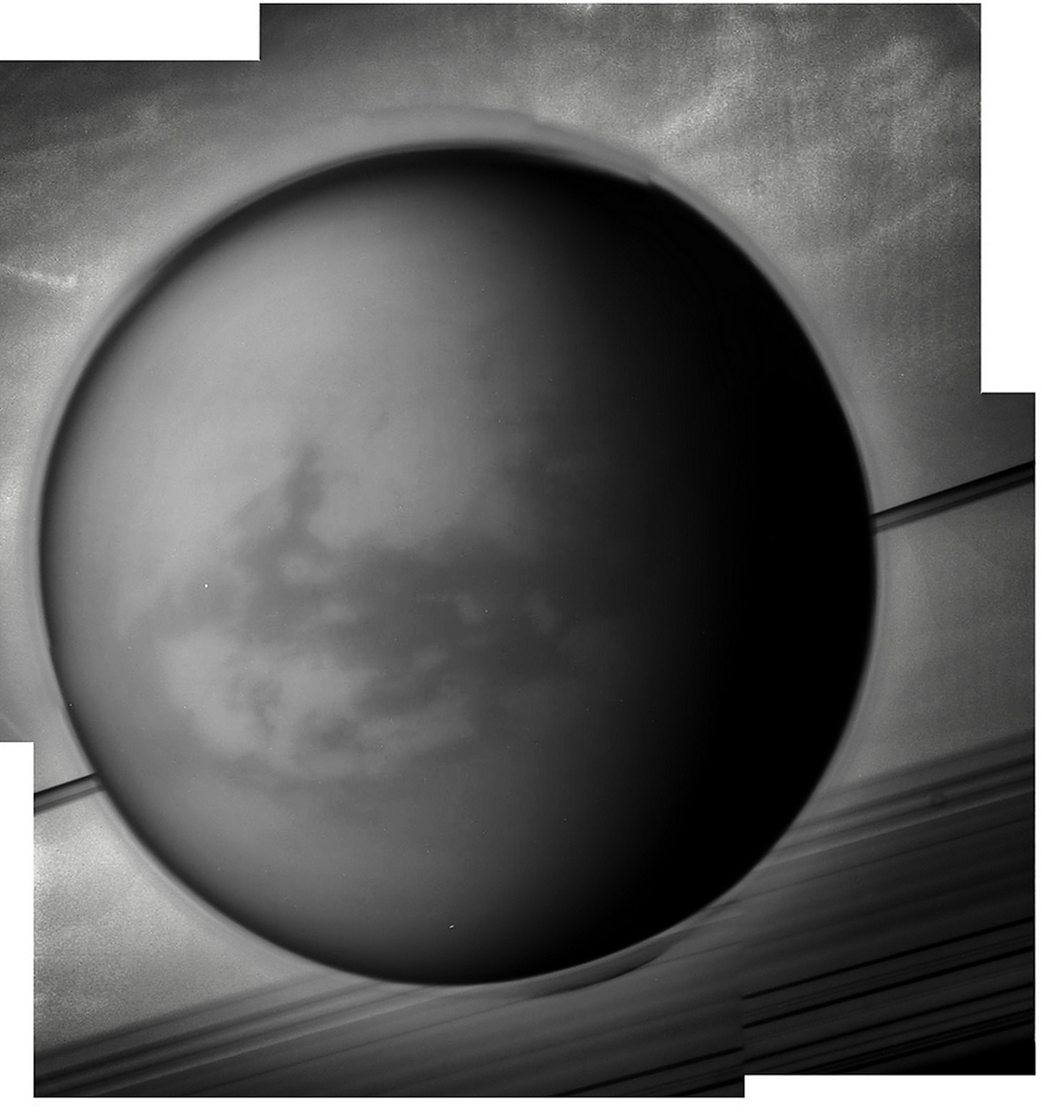
Credits: NASA/JPL/Space Science Institute - Credits for the additional process.: Elisabetta Bonora and Marco Faccin/Lunar Explorer Italia/IPF
|
The Atmosphere of Titan is mostly (98,4%) made by Nitrogen — the only dense, Nitrogen-rich Atmosphere existing in the Solar System, aside the Earth's one — with the remaining 1,6% composed of Methane (1,4%) and Hydrogen (0,1 – 0,2%). Since Methane condenses out of the Titanian Atmosphere - such as at very high altitudes -, its abundance increases once we descend below the Tropopause, such as at an altitude of approx. 32 Km, and then it levels off - at an average value of 4,9% - between 8 Km above the Datum and the Surface of Titan. We do not have to forget, however, that the Atmosphere of Titan also contains "trace amounts" of other Hydrocarbons, such as Ethane, Diacetylene, Methylacetylene, Acetylene and Propane, as well as of other gases (including Cyanoacetylene, Hydrogen Cyanide, CO2, CO, Cyanogen, Argon and Helium). The yellow/orange color of the Atmosphere of Titan, as seen from Space, should be produced by other (and, likely, way more complex) chemicals which exist over there in relatively small quantities - possibly Tholins, such as Tar-like Organic Precipitates. The Hydrocarbons are thought to form in Titan's Upper Atmosphere through a reaction resulting from the breakup of Methane (a molecular breakup due to the action of the UltraViolet Light coming from the Sun which causes a chemical reaction that, in its final stage, produces a thick yellow/orange smog). Titan has no Magnetic Field, although studies made in the AD 2008 showed that Titan retains some remnants of Saturn's Magnetic Field on the brief occasions where it passes outside the Saturnian Magnetosphere and it gets directly exposed to the Solar Wind. This event may cause an Ionization of molecules existing near the top of the Titanian Atmosphere. In November 2007, Scientists uncovered evidence of Negative Ions (with roughly 10.000 times the mass of Hydrogen) in Titan's Ionosphere which were (and still are) believed to fall into its lower regions, where they finally concur to form the orange Haze that, in fact, obscures almost the entire Surface of Titan from the view of Observers located in Space (like the NASA - Cassini Spacecraft). Their structure is not currently known, but they are believed to be Tholins, and they may form the basis for the formation of more complex molecules, such as Polycyclic Aromatic Hydrocarbons. Energy from the Sun should have converted all traces of Methane in Titan's Atmosphere into more complex Hydrocarbons within 50 Million Years — which is a short time, if compared to the age of the Solar System - and this suggests that Methane must be somehow replenished by a reservoir that should be located on (or within, maybe) Titan itself. The Titanian Atmosphere contains over a thousand times more Methane than Carbon Monoxide and this fact, once we look at it carefully, appears to rule out any significant contributions to its formation that might have come from Cometary Impacts (since Comets - as far as we know - are composed of larger quantities of Carbon Monoxide than Methane); furthermore, even the hypothesis that Titan might have accreted an Atmosphere from the early Saturnian Proto-Planetary Nebula seems unlikely: in such a case, in fact, Titan should possess an Atmospheric abundance of Elements similar to the ones that are present in the Solar Nebula (including, among others, Hydrogen and Neon)! But neither of these Elements, as a matter of fact, is there. Many Astronomers have also suggested that the ultimate origin for the Methane existing in Titan's Atmosphere is from within Titan itself (such as from its Sub-Surface or even somewhere near or within the Mantle), and it is released via Eruptions from Cryovolcanoes; however, a possible biological origin of the Titanian Methane has not been discounted yet. There is also a pattern of Air Circulation found flowing in the direction of Titan's Rotation, from West to East, and several observations (made by the NASA - Cassini Spacecraft during the AD 2004) suggested that Titan is a "Super Rotator" (such as a Celestial Body whose Atmosphere rotates faster than its Surface), just like the Planet Venus. Titan's Ionosphere is also more complex than Earth's, with the Main Ionosphere at an altitude of approx. 1200 Km but with an additional layer of charged particles at 63 km. This fact splits the Atmosphere of Titan to some extent into two separate Radio-Resonating Chambers. The source of natural Extremely Low Frequency (ELF) Waves on Titan, as detected by the NASA - Cassini Spacecraft, is unclear, since it does not appear to be any extensive lightning activity over there. Titan's Internal Magnetic Field is negligible, and perhaps even nonexistent. Its Mean Orbital Distance from its Parent Planet, however (distance that is made of 20,3 Saturnian Radii) does place Titan within Saturn's Magnetosphere, occasionally. In any case, though, the difference between the Rotational Period of Saturn (which is 10,7 hours) and Titan's Orbital Period (that is equal to 15,95 days) causes a Relative Speed of about 100 Km/sec. between the Saturnian Magnetized Plasma and the one of Titan. And this circumstance, in fact, can actually intensify reactions that, instead of protecting the Atmosphere of Titan from being eroded by the Solar Wind, may cause, in the end, its substantial reduction. |
News visualized: 848 times