

May 20, 2012

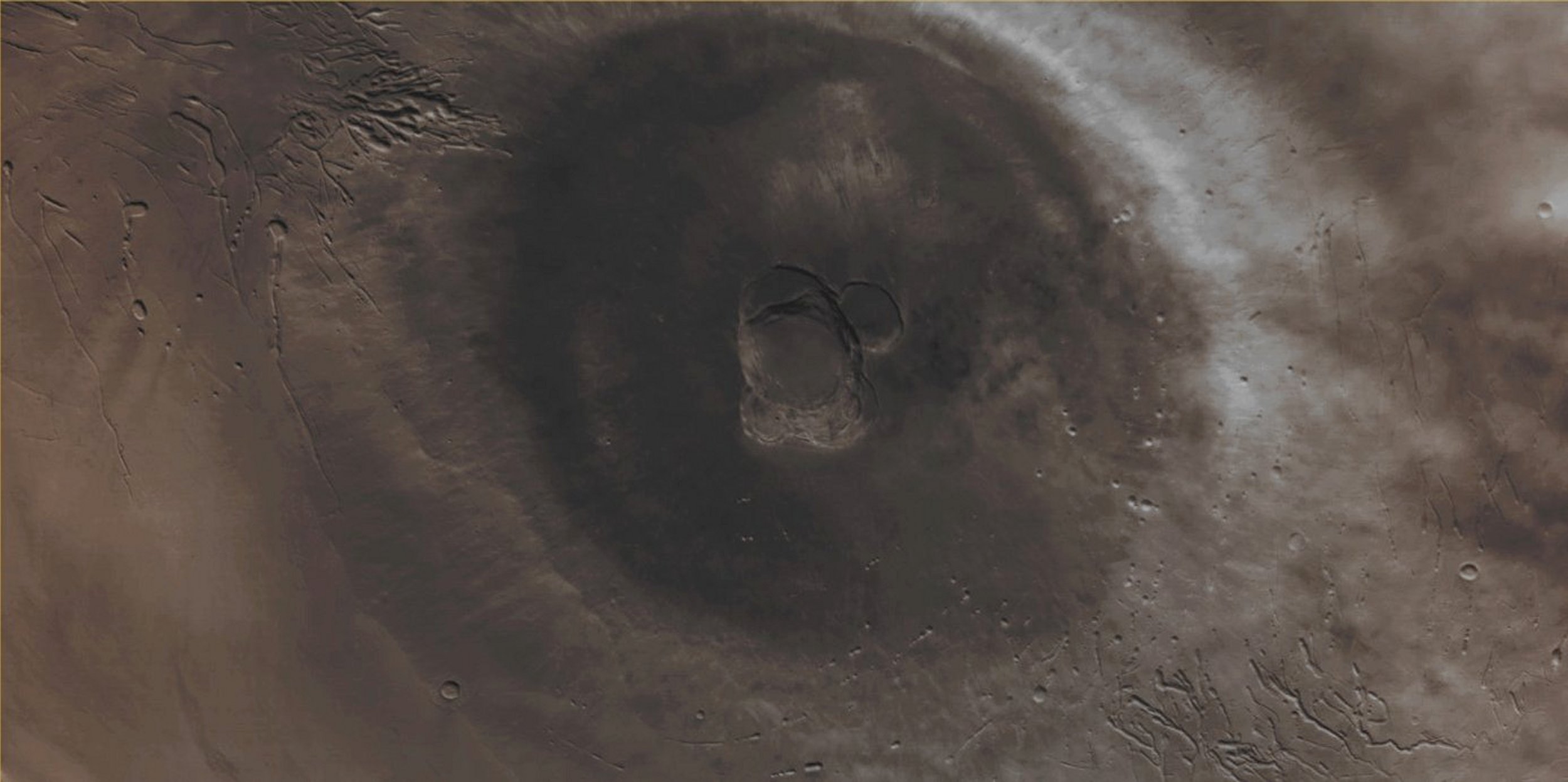
Credits: NASA/JPL/MSSS - Mars Global Surveyor Mission - Credits for the additional process.: Dr Paolo C. Fienga/Lunar Explorer Italia/IPF
|
Today's APOD is a red wide angle Mars Global Surveyor (MGS) Mars Orbiter Camera (MOC) image that shows us the Martian Volcano known as Ascraeus Mons, such as the Northernmost of the 3 (three) Tharsis Montes (Shield Volcanoes). Ascraeus Mons is located in the South/Eastern-central portion of the Tharsis Quadrangle at about 11,8° North Lat. and 255,5° East Long., in the Western Hemisphere of Mars. A group of other 3 (three) smaller Volcanoes (the so-called Ceraunius-Uranius Group) lies about 700 km to the North/East, while Pavonis Mons (the middle Volcano of the Tharsis Montes) lies approx. 500 Km to the South/West. As a further geographic reference, consider that the approx. 70-Km diameter Impact Crater Poynting, is located about 300 Km to the West/South-West. Ascraeus Mons is roughly 480 Km in diameter and is the second highest mountain of Mars, with a Summit elevation of 18,1 Km above the "Martian Datum" (or Mars' Ground Zero); it has a very low profile with an average Flank Slope of about 7° only. The Slopes, anyway, get much steeper in the middle portion of its Flanks, then they flatten out toward the base and near the top ov the Volcano, where a broad Summit Plateau and a Caldera Complex are located. Several Volcanic Vents, located on the North/Eastern and South/Western Edges of the Volcano, are thought to be the sources for broad Lava Aprons, or Fans, that buried the nearby portions of the Volcano itself and which extend for over 100 km out into the surrounding Lava Plains. The South/West-North/East orientation of the Aprons matches the orientation of the Tharsis Montes, suggesting that a Major Fissure (or Rift) in the Martian Crust is (better yet: could likely be) responsible for the orientation of both the Aprons as well as the Tharsis Montes Chain. The presence of the Lava Aprons caused (and still causes) some disagreement in the Scientic Community about the actual dimensions of the Volcano. However, if the Aprons are included as part of the Volcanic Edifice, then the dimensions of Ascraeus Mons get closer to 375 × 870 Km. Just like most of the Tharsis Region, even Ascraeus Mons has a high Albedo (---> Reflectivity) and low Thermal Inertia (which, as its name clearly implies, represents the ability of a material to conduct and store heat and, in the context of Planetary Science, it is the measure of the Subsurface's ability to store heat during the Day and to reradiate it during the Night), indicating that the Volcano, as well as the surrounding areas, are covered with large amounts of fine Dust that forms a thick Mantle over the entire Surface; a Mantle that is capable to obscure (or even mute) much of the fine-scale Topography and Geology of the Region. However, we believe that Tharsis is so Dusty because of its Mean High Elevation: consider, in fact, that the Summit of Ascraeus Mons, for instance, experiences an Atmospheric Pressure of LESS than 130 Pa (such as LESS than 1,3 millibars - and note that 1,3 millibars represent something like approx. 21% of the Mean Surface Pressure of the Red Planet. In other words: the Atmospheric Density, at Tharsis, is (in average) way too low to either mobilize and/or remove Dust once it is deposited. This frame has been colorized in Absolute Natural Colors (such as the colors that a human eye would actually perceive if someone were onboard the NASA - Mars Global Surveyor Orbiter and then looked down towards the Surface of Mars), by using an original technique created - and, in time, dramatically improved - by the Lunar Explorer Italia Team. |
News visualized: 817 times