

May 19, 2012

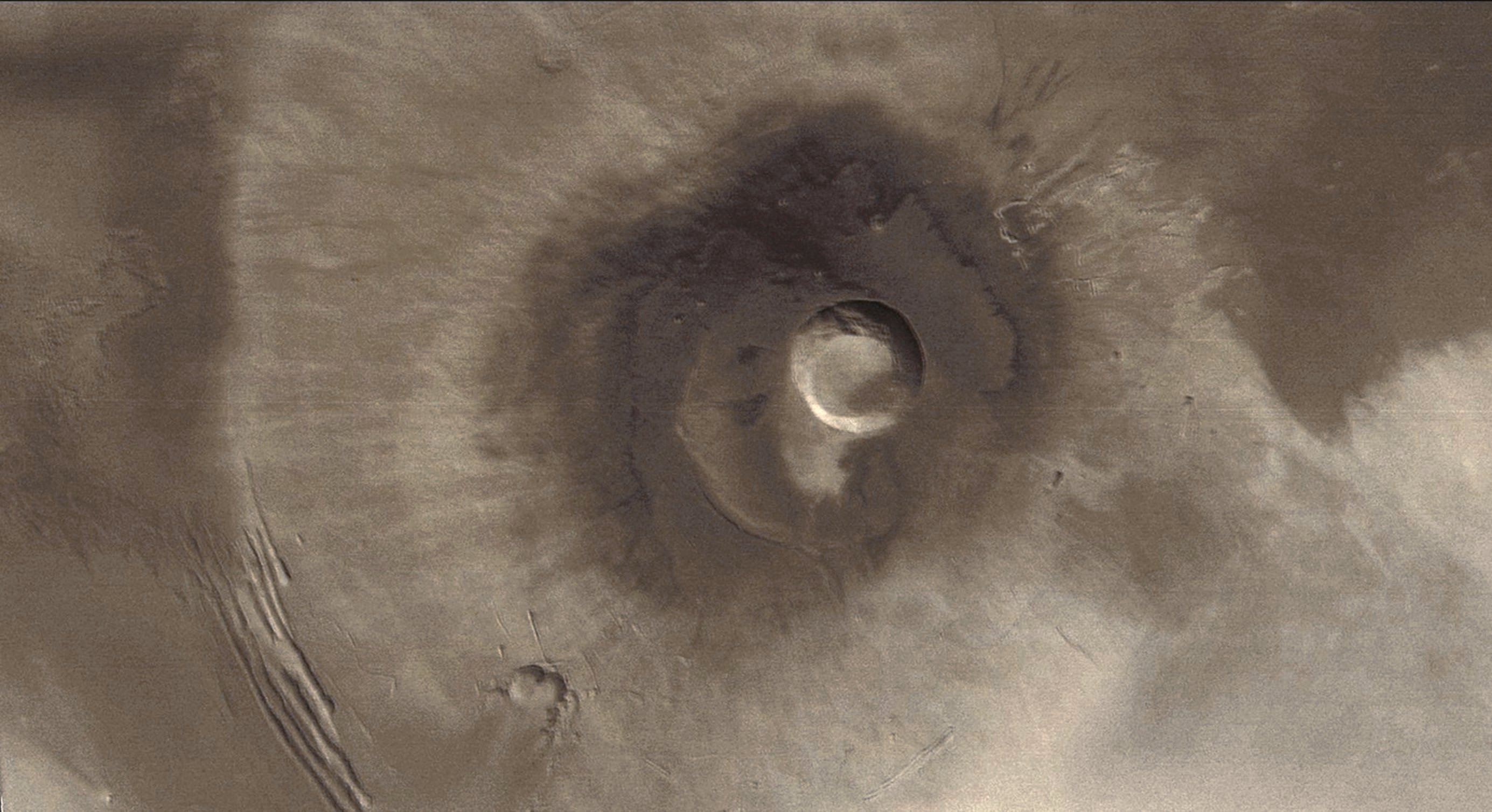
Credits: NASA/JPL/MSSS - Mars Global Surveyor Mission - Credits for the additional process.: Dr Paolo C. Fienga/Lunar Explorer Italia/IPF
|
Today's APOD is a NASA - Mars Global Surveyor (MGS) Mars Orbiter Camera (MOC) wide angle composite image - obtained in December of the AD 2003 - which shows us the smallest of the three Tharsis Montes, such as Pavonis Mons. Pavonis Mons is a "Broad Shield Volcano" (quite similar, as far as its shape is concerned, to the Volcanoes existing in the Hawaii Islands) located on the Martian Equator at approx. 113° West Long. The Volcano Summit is near 14 Km (~ 8,7 miles) above the Martian Datum (such as "0" - zero - elevation); the central Caldera (such as the crater visible near the center of the frame) is about 45 Km (~ 28 miles) across, and approx. 4,5 Km (~ 2,8 miles) deep. Sunlight illuminates the scene from the lower left. Pavonis Mons stands at the Southern Edge of the Tharsis Quadrangle - such as approximately 400 Km South/West of Ascraeus Mons (which is the Northernmost of the Tharsis Montes) and approx. 400 Km North/East of Arsia Mons (which is, on the other side, the Southernmost member of the Chain). The Tharsis Montes lie along the Crest of a North-to-East-trending Rise (known as "The Tharsis Bulge") that extends more than 3000 Km across the Western Equatorial Regions of Mars. Olympus Mons (that, as you know, the largest and tallest known Volcano of the Solar System), lies at the edge of the Tharsis Bulge, such as about 1200 Km North/West of Pavonis Mons. Being a so-called "Shield Volcano", Pavonis Mons has an extremely low Profile with Flank Slopes that average only 4°. Its Summit contains a deep, circular Caldera that, as we said before, is approx. 45 km in diameter and a little more than 4,5 Km in depth. Like most of the Tharsis Region, Pavonis Mons has a high Albedo (---> Reflectivity) and low Thermal Inertia (which, as its name clearly implies, represents the ability of a material to conduct and store heat and, in the context of Planetary Science, it is the measure of the Subsurface's ability to store heat during the Day and to reradiate it during the Night), indicating that the Volcano, as well as the surrounding areas, are covered with large amounts of fine Dust that forms a thick Mantle over the entire Surface; a Mantle that is capable to obscure (or even mute) much of the fine-scale Topography and Geology of the Region. However, we believe that Tharsis is so Dusty because of its Mean High Elevation: consider, in fact, that the Summit of Pavonis Mons, for instance, experiences an Atmospheric Pressure of around 130 Pa (such as 1,3 millibars only), which is about 21% of the Mean Surface Pressure of the Red Planet. In other words: the Atmospheric Density, at Tharsis, is (in average) way too low to either mobilize and/or remove Dust once it is deposited. This frame has been colorized in Absolute Natural Colors (such as the colors that a human eye would actually perceive if someone were onboard the NASA - Mars Global Surveyor Orbiter and then looked down towards the Surface of Mars), by using an original technique created - and, in time, dramatically improved - by the Lunar Explorer Italia Team. |
News visualized: 964 times