May 17, 2012

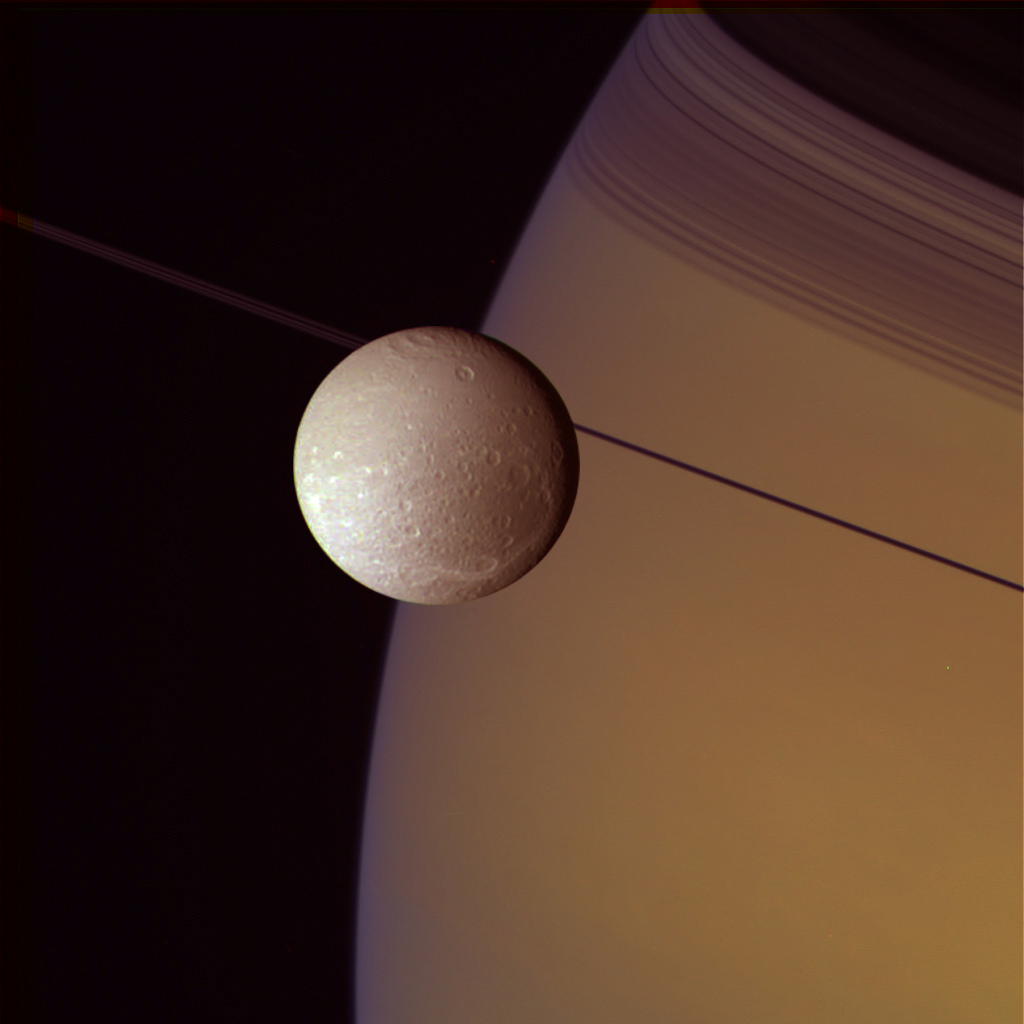
Credits: NASA/JPL/Space Science Institute - Credits for the additional process. and color.: Elisabetta Bonora and Marco Faccin/Lunar Explorer Italia/IPF
|
With its diameter of approx. 1120 Km, the Saturnian moon Dione is the 15th largest moon in the Solar System, and (apparently) it is more massive than all the other (and smaller) known moons put together. Dione is primarily composed of Water Ice but, as the third densest of Saturn's moons (after Enceladus and Titan, whose density is also increased by way of a physical phenomenon known as Gravitational Compression), it must also have a considerable fraction (~ 45%) of denser material - like Silicate Rock - in its interior. Even though it is a little smaller and denser, Dione is otherwise very similar to another well-known Saturnian moon: Rhea. As a matter of fact, both moons have similar Albedo Features and Varied Terrain, as well as they both have deeply dissimilar Leading and Trailing Hemispheres. Dione's Leading Hemisphere, for instance, is heavily cratered and is uniformly bright while its Trailing Hemisphere, instead, contains an unusual and very distinctive Surface Feature: a network of bright Ice Cliffs (the so-called "Wispy Terrain"). Planetary Scientists have recognized and then classified the Dionean Geological Surface Features into 5 (five) main cathegories: Chasmata (meaning long, deep and steep-sided Depressions); Dorsae (such as Ridges); Fossae (long and narrow Depressions); Impact Craters and Catenae (which can either be Pit Chains and/or Crater Chains). This frame has been colorized in Natural Colors (such as the colors that a perfect human eye would actually perceive if someone were onboard the NASA - Cassini Spacecraft and then looked outside, towards the Saturnian moon Dione), by using an original technique created - and, in time, dramatically improved - by the Lunar Explorer Italia Team. |
News visualized: 865 times