

May 16, 2012

Credits: NASA/Johns Hopkins University Applied Physics Laboratory/Carnegie Institution of Washington and Dr Paolo C. Fienga for the additional process. and color.
|
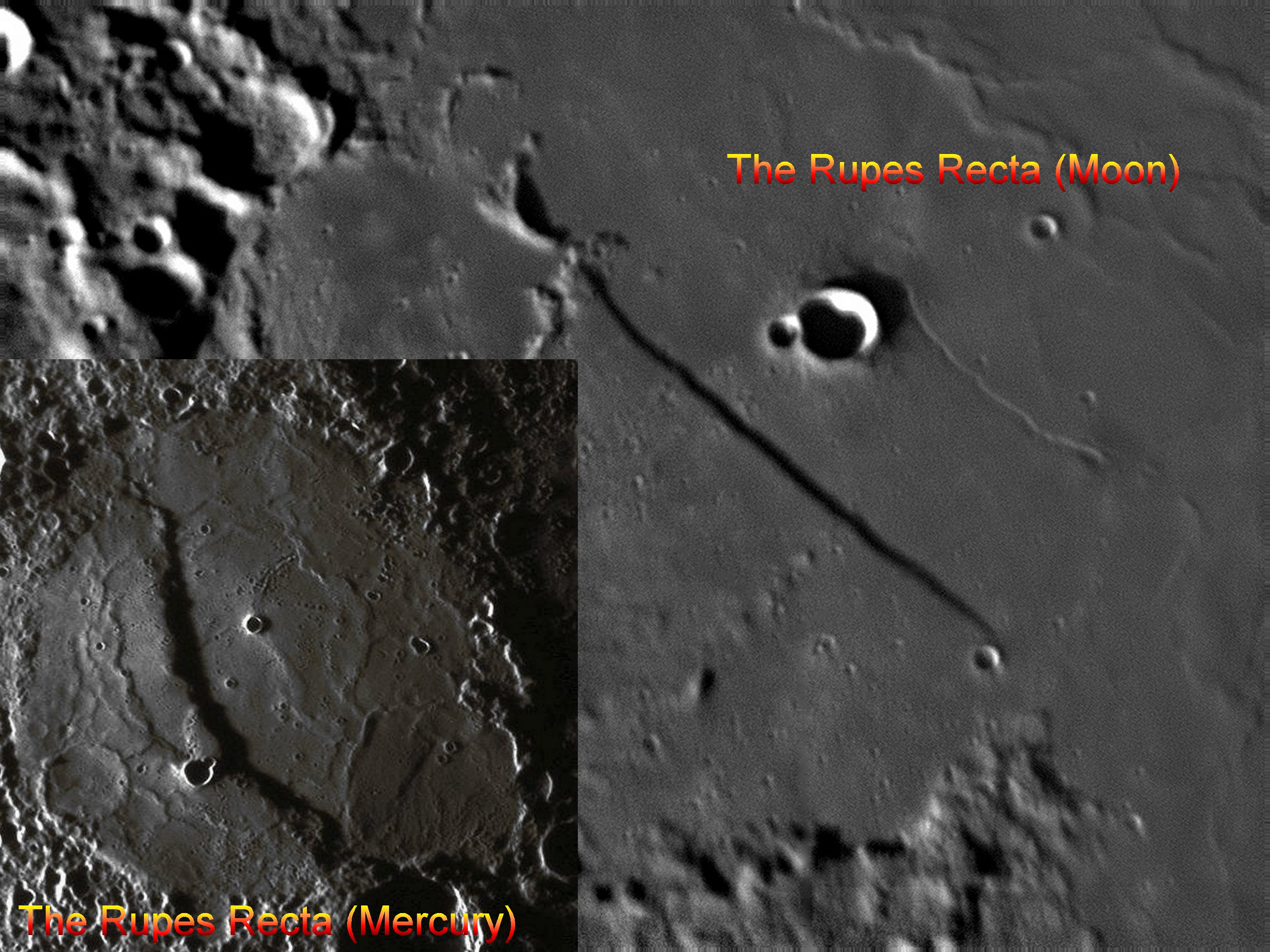
The Scarp cutting through this Mercurian Unnamed Impact Crater was imaged as the NASA - MESSENGER Spacecraft approached the Planet during the mission's second Fly-By. The similarities between this Mercurian Scarp (as well as the Crater surrounding it) and another Surface Feature, located on the Moon and known as "Rupes Recta", are, in our opinion, very remarkable - even though the Mercurian Scarp is obviously more arcuate than the Lunar one (note: the Rupes Recta is a Linear Fault, or Rille, located on the Moon, in the South-Eastern part of the Mare Nubium, at about 22,1° South Latitude and 7,8° West Longitude. The name is Latin for "Straight Fault", although this Surface Feature is more commonly known as "The Straight Wall". The Rupes Recta is the most well-known Escarpment existing on the Moon, and it is also a VERY popular target for amateur astronomers. When the Sun illuminates the Feature at an oblique angle, around Day 8 of the Moon's orbit, the Rupes Recta casts a wide shadow that gives it the appearance of a Steep Cliff. The Lunar Rupes Recta has a length of approx. 110 Km, a typical width of 2–3 Km and a height of approx. 240–300 mt. Even though the Rupes Recta appears to be a Vertical Cliff on the Lunar Surface, the actual grade of the slope is relatively shallow (low). To the West of the Rupes, lays the Crater Birt, which is about 10,5 miles in diameter. Also to the West is the Rima Birt Rille. At the Southern End of the Fault, there is a group of Hills often called the "Stag's-Horn Mountains", although this name is not officially recognized by the IAU. To the North-East of the Rupes, the Crater Alpetragius can be found, while to the East lays the Crater Thebit). Date Acquired: October 6, 2008 Image Mission Elapsed Time (MET): 131766501 Instrument: Narrow Angle Camera (NAC) of the Mercury Dual Imaging System (MDIS) Resolution: 420 meters/pixel (i.e.: 0,26 miles/pixel) Scale: This Unnamed Crater is about 200 Km (approx. 124 miles) in diameter Spacecraft Altitude: 16.300 Km (about 10.100 miles) The frame positioned on the lower left has been colorized in Absolute Natural Colors (such as the colors that a human eye would actually perceive if someone were onboard the NASA - MESSENGER Spacecraft and then looked down, towards the Surface of Mercury), by using an original technique created - and, in time, dramatically emproved - by the Lunar Explorer Italia Team. |
News visualized: 958 times