
May 15, 2012

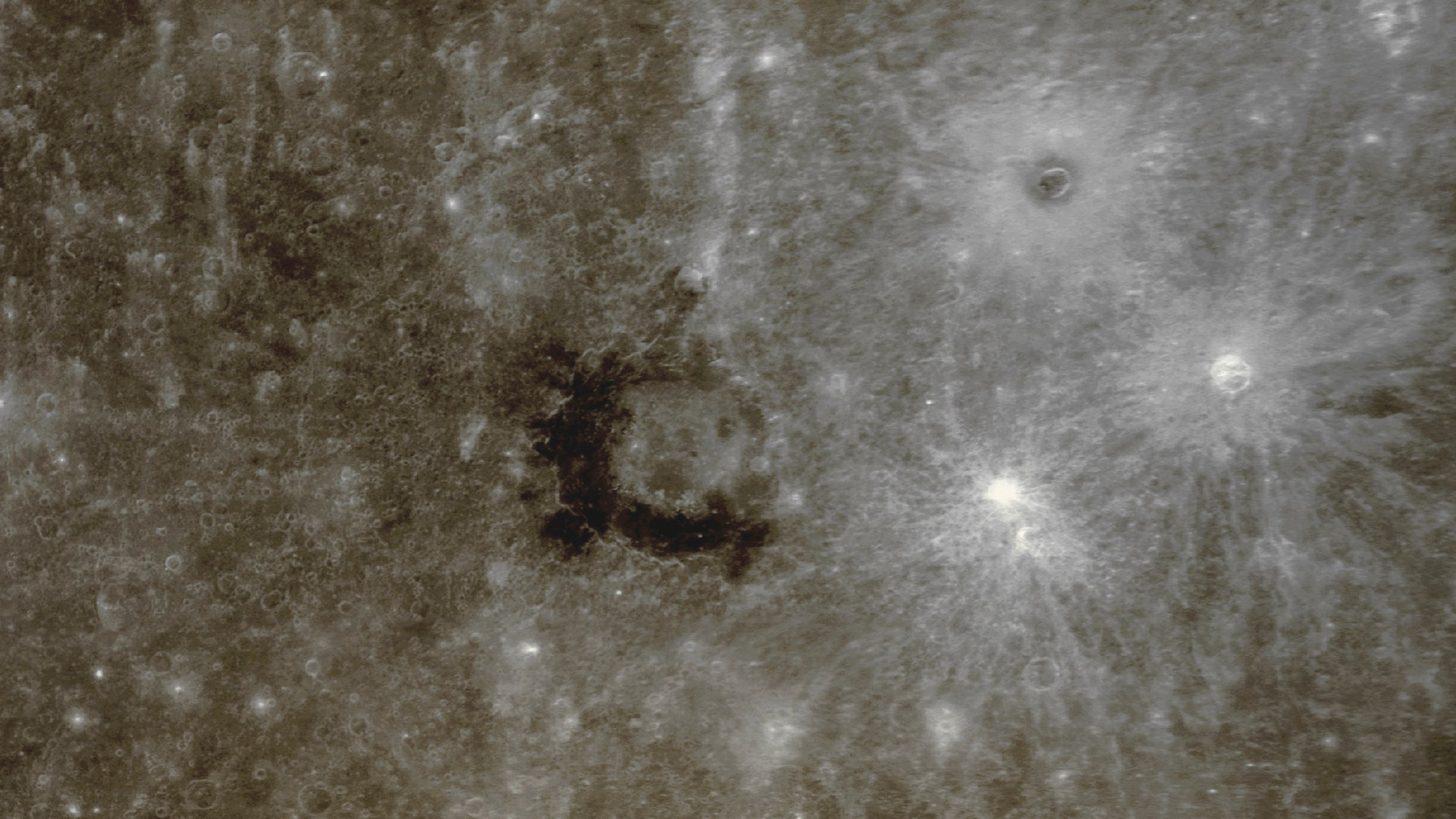
Credits: NASA/Johns Hopkins University Applied Physics Laboratory/Carnegie Institution of Washington and Paolo C. Fienga for the additional process. and color.
|
In the center of this image is an interesting (and, in a way, almost unique to Mercury) Impact Crater that was first viewed during NASA - MESSENGER Spacecraft's 2nd Mercury Fly-By (which occurred during the AD 2008) and then officially named "Derain" by the International Astronomical Union (IAU) about one year later. Derain Crater, as you can see in today's APOD, has Deposits of Dark Material within it and in its surroundings: a Material that is way much darker than the neighboring Terrain. In fact, the Material associated with Derain appears to have the lowest reflectance (---> Albedo) yet identified on Mercury's Surface. These Dark Deposits should be made of Rock possessing a Mineralogical Composition that is very different from the majority of Mercury's visible Surface, but more data are needed before any further insight into the composition of this intriguing Feature can be gained. The observations which are now being acquired (such as during the MESSENGER's Orbital Mission Phase) will help us to identify the uncommonly Dark Material at Derain Crater as well as similar occurrences (if any) elsewhere on the Planet. Also visible in this image (upper right side), is the Rayed Impact Crater "Berkel", which has Dark Material too, both in its center and also in an outer ring immediately surrounding it. In contrast, two neighboring Craters of Berkel have Bright Rays but lack Dark Halos. Why do some Impact Craters contain Dark Materials while others do not? MESSENGER's orbital data will be used to investigate that question and to improve our understanding of the nature and structure of Mercury's Crust. Date Acquired: October 6, 2008 Instrument: Narrow Angle Camera (NAC) of the Mercury Dual Imaging System (MDIS) Scale: Derain Crater is approx. 190 Km in diameter (such as about 118 miles) This frame has been colorized in Absolute Natural Colors (such as the colors that a human eye would actually perceive if someone were onboard the NASA - MESSENGER Spacecraft and then looked down, towards the Surface of Mercury), by using an original technique created - and, in time, dramatically improved - by the Lunar Explorer Italia Team.
|
News visualized: 869 times