May 14, 2012

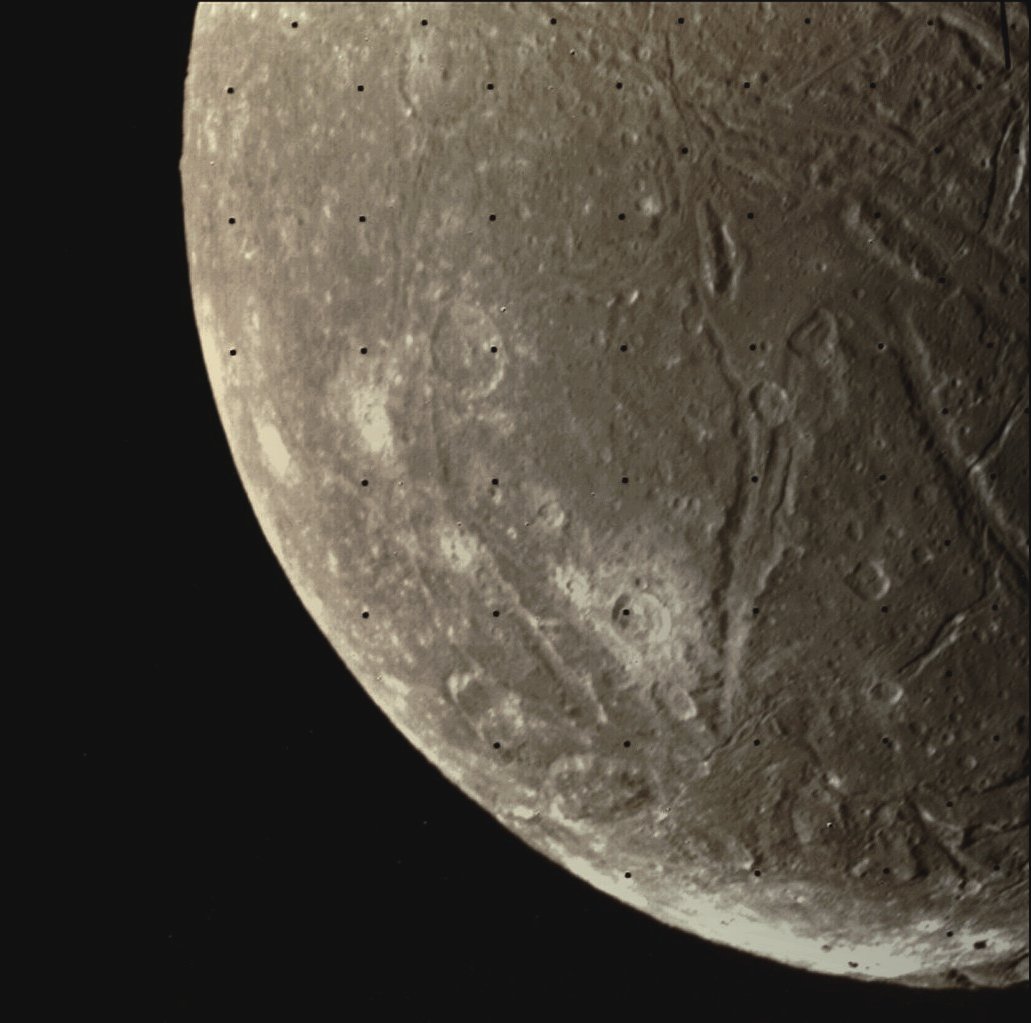
Credits: NASA - Voyager 2 Project; Credits fo the additional process. and color.: Dr Paolo C. Fienga/LXTT/IPF
|
Ariel (discovered in the month of October of the AD 1851 by Dr William Lassell) is the brightest and 4th (fourth) largest of the (so far) 27 known moons of the Giant Gas Planet Uranus; since Ariel orbits and rotates in the Equatorial Plane of Uranus, which is almost perpendicular to its orbit, it is logical to assume that this fact is the cause, to this moon, of a really Extreme Seasonal Cycle. As of today, much of the knowledge and information that we possess about Ariel derives from a single Fly-By of Uranus that was performed by the NASA - Voyager 2 Probe in the AD 1986: an historical Fly-By which managed to image approximately 35% of the moon's Surface. There are no active plans, at present time, to return there and then study this moon in more detail, although various concepts (such as an Uranus Orbiter and Probe) have been and are still proposed, every now and then. After Miranda, Ariel is the second-smallest of Uranus' 5 (five) Major Rounded Natural Satellites, and the second-closest to its Parent Planet. Among the smallest of the Solar System's 19 (nineteen) known Spherical moons (note that Ariel ranks 14th among them in diameter), Ariel is believed to be composed of roughly equal parts of Water Ice and Rocky Material. Like all of Uranus' moons, Ariel probably formed from an Accretion Disc that surrounded the Gas Giant Planet shortly after its formation, and, like other large moons, it is probably somehow differentiated, with an Inner Core of Solid Rock surrounded by a Mantle of Water Ice. Ariel has a Complex Surface consisting of extensive Cratered Terrain cross-cut by an intricated system of Scarps, Canyons and Ridges. The Surface shows signs of more recent geological activity than other Uranian moons, but this fact is most likely due to a phenomenon known as "Tidal Heating". The extremely bright Surface of Ariel (brightness that is very probably caused by to the presence, all over it, of large patches of Water Ice) shows an Opposition Surge: meaning that its reflectivity decreases from 53% at a Phase Angle of 0° (---> Geometrical Albedo) to 35% at a Phase Angle of about 1°. The Bond Albedo of Ariel, on the other hand (note that this kind of Albedo - which was named after the American Astronomer George Phillips Bond (1825 – 1865), who originally proposed it - is the Fraction of Power in the Total Electromagnetic Radiation incident on a Celestial Body that is Scattered back out into Space. Remember that the Bond Albedo takes into account all Wavelengths at all Phase Angles) is about 23% — such as the highest among all the Uranian Natural Satellites. The Surface of Ariel is generally neutral in color but there could be, anyway, an asymmetry between its Leading Hemisphere as to the Trailing one, since the second (such as the Trailing Hemisphere) appears to be redder than the Leading one by about 2%. Furthermore, Ariel's Surface (in general) does not show nor suggests the presence of any kind of correlation between Albedo and Geology on one side, and Albedo and Color on the other one: for instance, Ariel's Canyons seem to have the same color as the Cratered Terrain (but this last circumstance, however, once you consider the deep darkness characterizing all the Celestial Bodies - and therefore their Surface Features - which are located in this remote Region of the Solar System, should not surprise you at all, since the lack of color (which in this case, in our opinion, as IPF, is only apparent) is very likely due to a lack of light (better yet: is due to the lack of sufficient illumination!). Last, but not least, bright Impact Deposits around some (relatively) fresh Craters are slightly bluer in color. Now, even though the presence of a number of "Blue Spots" on the Surface of Ariel has been confirmed, their true nature is still unknown (even though it is possible and reasonable to speculate that these Blue Spots could just be piles of Water Ice - maybe, why not?!?, the residues of several - and likely countless... - Cometary Impacts). This frame has been colorized in Absolute Natural Colors (such as the colors that a human eye would perceive if someone were onboard the NASA - Voyager 2 Probe and then looked outside, towards the Uranian moon Ariel), by using an original technique created - and, in time, dramatically improved - by the Lunar Explorer Italia Team.
|
News visualized: 846 times