
May 9, 2012

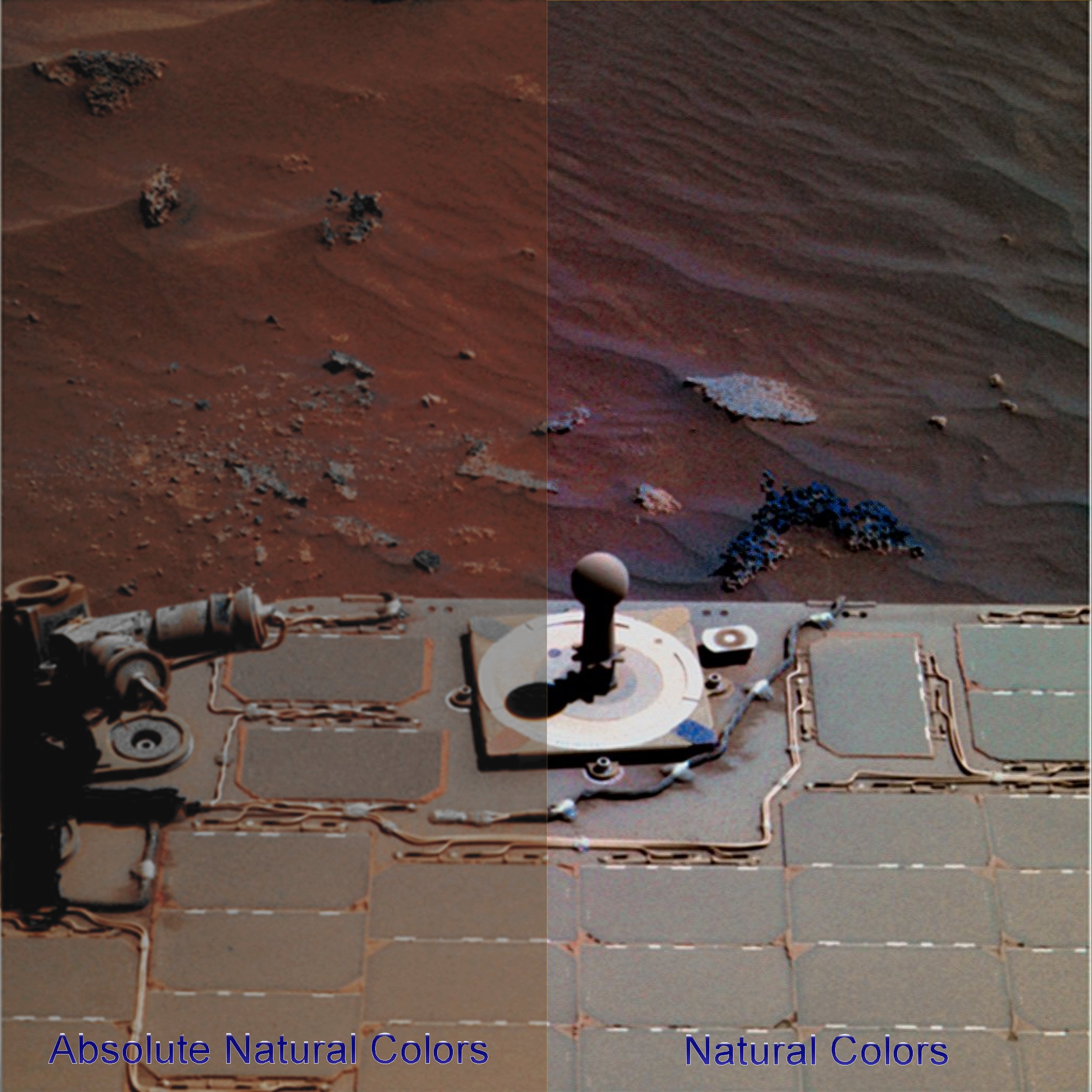
Credits: NASA/JPL/Cornell/USGS - MER Spirit - Credits for the additional process. and color.: Drr Gianluigi Barca and Paolo C. Fienga/Lunar Explorer Italia/IPF
|
How many times did you hear about the "Colors of Mars"? How many times, in the NASA-written captions of the color-frames from the Red Planet (or elsewhere, in the Solar System), have you read things like "True Colors", "Approximate True Colors", "Natural Colors" and, of course, "False Colors"? What does that mean? For instance, what is (and where is it, if any) the difference between the so-called "True" and the "Natural" colors? When in doubt, usually the best thing to do is to ask. And if nobody answers, then it is maybe time to work by yourself and then, if possible (try), to find your own answers. And so we (as IPF) did, in the past 8 years. As a matter of fact, in the past twenty years (at least!) we have witnessed to so many issues and disputes about a number of things relating to Mars that we have lost count; but one issue more than the others (even more than the alleged "Martian Sphynx" of Cydonia Mensae) appears to be really unsolvable and can be resumed in a simple and direct question: which ones are the Real Colors of Mars? Well, our Friends from NASA are the ones (at least in theory) who have, and always had, the VERY BEST skills, means, and capacities to give us a final answer but, ironically, if we are still here, discussing once again this (now quite old) topic, it's really because the People from Pasadena, apparently, have not - yet? - supplied us with a credible, fully satisfying, and coherent solution. As we already said and written in the past, the color-frames from NASA (and it does not matter if they are "orbital" or "from the Ground") did not clarify anything at all and, if possible, they heavily contributed to create an even bigger confusion. We have seen frames in both "True", "Approximately True", "Natural" and "Approximately Natural" Colors that all looked the same and, on the other hand, we have seen color-frames belonging to the same Cathegory (one of the five Main ones, such as "True", "Approximately True", "Natural", "Approximately Natural" and "False" colors) which were completely different from one another. We have seen "butterscotch", "deep and dark yellow", "thick and opaque green", "blueish", "orange", "white" and even "light yellow" Martian Skies, as well as we have seen the Martian Surface "painted" (litterally) in a number of ways, where many of them were/are even really unlikely and they looked - at least at first sight - absolutely fake. And why all this? Well, we cannot supply you with the "Truth", of course, for the simple reason that we have not been there (on Mars) to see and verify with our own eyes, but we can still give you a few ideas about the possible reasons of this confusion. One reason (probably the main reason), is that, sometimes, technology is overrated. The way that "Human Eyes" and "Electronic Eyes" see things is deeply different. Many Scientists say that the "Electronic Eyes" see better than "Humans'" and, in a way, they are correct. But the point here is not the "best" vision, but the "correct" one (from a Human, we repeat, point of view). Let us not forget that, if we want to even just try to understand (a little bit of) an Alien World (like Mars), we have to look at it, in our opinion, with our own eyes. That is because, if, one day, we actually get there, we will have to rely first upon our own senses, and then on the machines, no matter how sophisticated and perfect they might be. Not vice-versa! We say so because we DO believe that the real "Instrument of Measure" of all things, as long as we are (and we shall remain) "Humans", is the Man, himself. Machines and Technologies are a GREAT help (and we mean this!), but, without a Man controlling and "calibrating" them, they are pretty much worthless. Back to our issue: the vision of Mars through the Electronic Eyes of a Rover or of an Orbiter is one thing, while the vision of Mars through our own eyes (even though they are not "that perfect" as we wish...) is another - and dramatically different - thing. Electronic Eyes catch more light than Humans', they can see "through" things (think about the Tau, or Atmospheric Opacity, for instance) better than our eyes; they can catch the Full Light Spectrum if they want to, while we can't. This three facts alone are just enough to say that a Vision obtained through Electronic Eyes is NOT and shall NEVER be a "Natural" Vision. As a consequence of this, the colors of a World that are caught by Electronic Eyes are NOT and shall NEVER be (actually, they simply cannot be) either "Natural", or "Approximately Natural". Are they "False", then? No, they are not "False": they are just different. Think about another thing: for the Human Vision, the so-called Lighting Conditions are more than important for a "correct vision": they are FUNDAMENTAL! And now, think about the Lighting Conditions existing, just to give you another scenario to think about, in the Space of Saturn, where our Sun shines just a little (VERY little!) more brightly than any other Star visible in the backgorund. How is it possible, then, to catch and see so very well all those details of the Saturnian Moons, since they receive such a little illumination? Or maybe when the ONLY source of light is the so-called "Saturnshine" (such as the Saturnian equivalent of the Terrestrial Moonshine - or Moonlight)? Did you ever try to walk in an unknown field, at night, when the only source of illumination was the Moonshine or just the Starlight (and, please, believe us if we strongly suggest you not to do that, especially if you are unfamiliar with the land you will be walking on...)? And, if you actually did that, were you able to see the landscape surrounding you in a way that was just half as good as the way the Cassini Orbiter sees the - VERY MUCH LESS ILLUMINATED! - Surface of Titan, or Rhea's, or Mimas'? Of course not! But, when you look at the frames from the NASA - CASSINI Orbiter, you can see even the slightest details of each and every photographed Saturnian Moon: why? The answer does not change: because Electronic Eyes see things in a different way than Humans'. And is that way a "Better" way than the Humans' one? Yes, of course: but only from a certain point of view. And, however, that "way" (that "vision") is NOT the "Human Way" (vision). And this is, always in our opinion, the main reason why the whole issue about the "True Colors" of Mars is just a pseudo-issue. As long as we shall use "Electronic Eyes" to look farther and beyond, we will certainly gather more information, we shall acquire more knowledge and we will see more things! But, in the end, we shall not (actually, we shall never) gain a "Human Vision" of all these new Worlds and Landscapes that we observed only throughout the "eyes" of machines. Using this (mainly Philosophical, we know and we admit it) approach, it is abvious that a final answer to the original question, as long as we sit here, comfortably, behind our computers and keyboards, shall never be given. And it shall not be given because it is is impossible to find it. On the other hand, though, we can use all the visual information and data collected by our Spacecrafts to speculate, to improve our knowledge of things and, if we are good enough, to create some new "Informed Theories". Theories that, as you can easily understand, shall look over anything we want, including the "Colors" of an Extraterrestrial (and therefore "Alien" - and "Unknown to Human Eyes" - by definition) World. In today's APOD, we wanted to give you an example of what we mean by "Informed Theory" (or "Informed Speculation"), when we talk about the Colors of Mars. So, we have taken one RAW b/w Frame from the NASA - Rover Spirit Collection, and we have colorized it by using two VERY different Techniques. The first one (on the left - Sx) is the colorization which obtains what we call "Absolute Natural Colors", such as the colors that a normal/in the average human eye would/should perceive if we were on Mars, at the time the picture was taken, near the Rover Spirit; the second one, is the colorization made in "Natural Colors", such as the colors that a PERFECT Human Eye (better yet: an Electronic Eye) would/should perceive, while being in the same situation that was described herebefore. In other words: the Natural Colorization reflects the Perfect/Complete Sight - which does not exist in the Human Vision (unless you have a CCD Camera where your eyeball should be) -, while the Absolute Colorization reflects/should reflect the average Human Sight. The difference is so obvious that it does not need any explanation. And, if you asked "which ones are the True Colors of Mars, according to this photo-composite?", the answer is even more obvious: none. And both, of course! Think about it.... |
News visualized: 959 times