

January 12, 2012

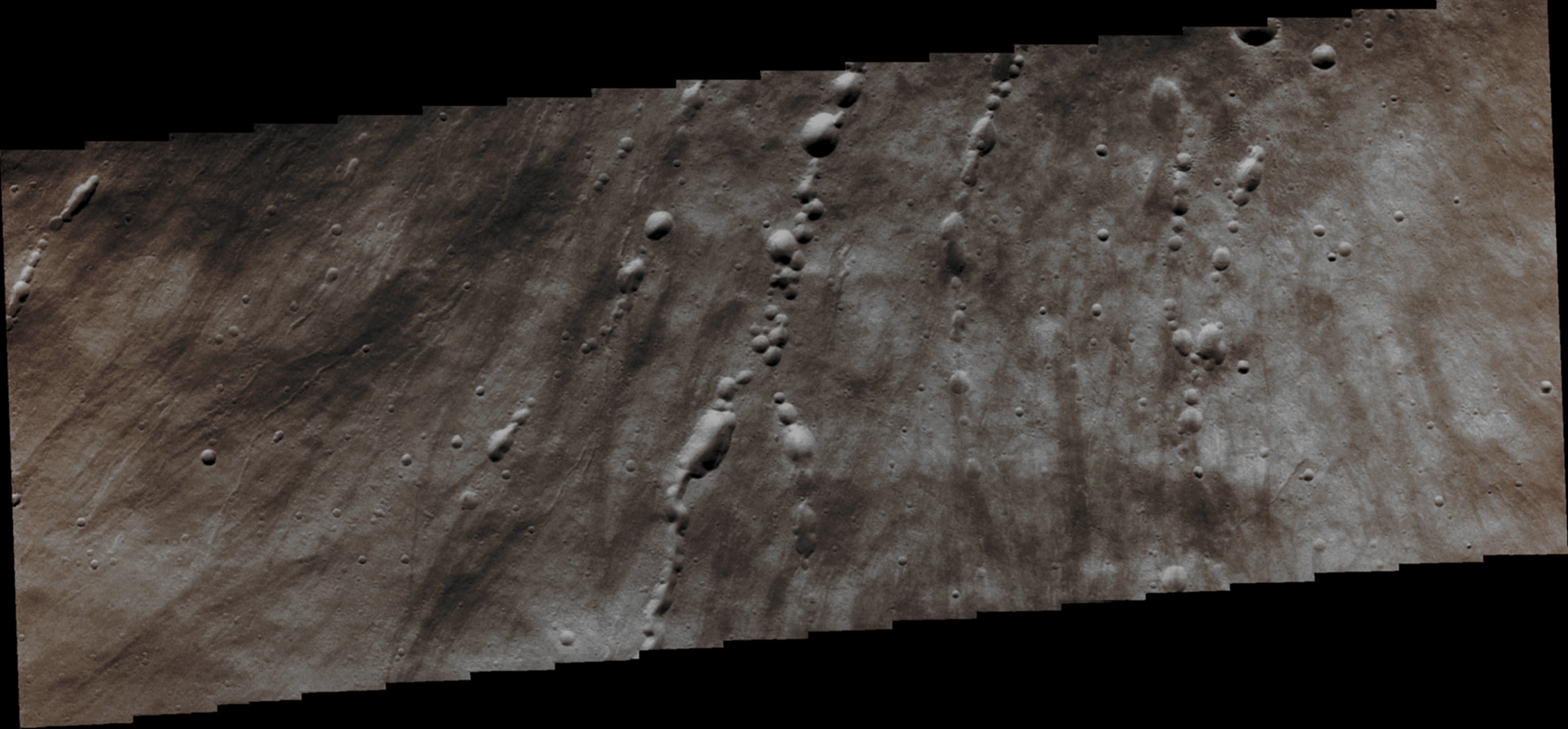
Credits: NASA/JPL/Arizona State University (ASU) - Credits for the additional process. and color.: Dr Paolo C. Fienga/Lunar Explorer Italia/IPF
|
This image, captured on December, 18th, 2011, by the NASA - Mars Odyssey Orbiter during its 44398th orbit, shows several interesting Surface Features located on the Western Flank of the giant Martian Volcano known as Elysium Mons. These beautiful Collapse Features are located at about 24,526° North Lat. and 146,044° East Long. Elysium Mons is one of the many gigantic Martian Volcanoes and is located in the Elysium Planitia, Eastern Hemisphere of the Red Planet, at approx. 24° North Lat. and 146° East Long. Elysium Mons stands about 13,9 Km above the surrounding Lava Plains and approx. 16 Km above the Martian Datum (such as the Zero Altitude - or "Sea Level" on Earth). Its diameter is approx. 240 Km and its Summit Caldera is about 14 Km across. Elysium Mons is flanked by two other smaller Volcanoes: Hecates Tholus, to the North, and Albor Tholus, to the South. It is interesting to mention the fact that Elysium Mons was first seen (and therefore "discovered") in the AD 1972, by examining the images returned by the NASA-Mariner 9 Orbiter. Elysium Mons, like most Martian Volcanoes, is litterally surrounded by countless fascinating geological features like, for instance, steep Scarps, Skylights, Single Collapse Pits, Collapse Pit-Chains and, as it can be clearly seen in this frame, by several dark Surface Striations which, in our opinion, were caused by strong Eolian Actions. If you look carefully, some deep tracks of rolling Boulders (having significant dimensions) can also be seen near the Pit-Chains as well as on top of the Surface Striations. The biggest rolling Boulders have also left clear signs of their passage both on the edges and inside some small Impact Craters which are visible all over the scene. The causes of these huge Boulders to start rolling down the Flank of the Volcano are likely related to phoenomena of Residual Seismic Activity and/or Gravity Wasting. Vibration of the Surface due to relatively close meteoritic impacts can also be considered as a possible cause of the rolling of these Boulders. This frame has been colorized in Absolute Natural Colors (such as the colors that a human eye would actually perceive if someone were onboard the NASA - Mars Odyssey Orbiter and then looked down towards the Surface of Mars), by using an original technique created - and, in time, dramatically improved - by the Lunar Explorer Italia Team. |
News visualized: 859 times