
May 7, 2012

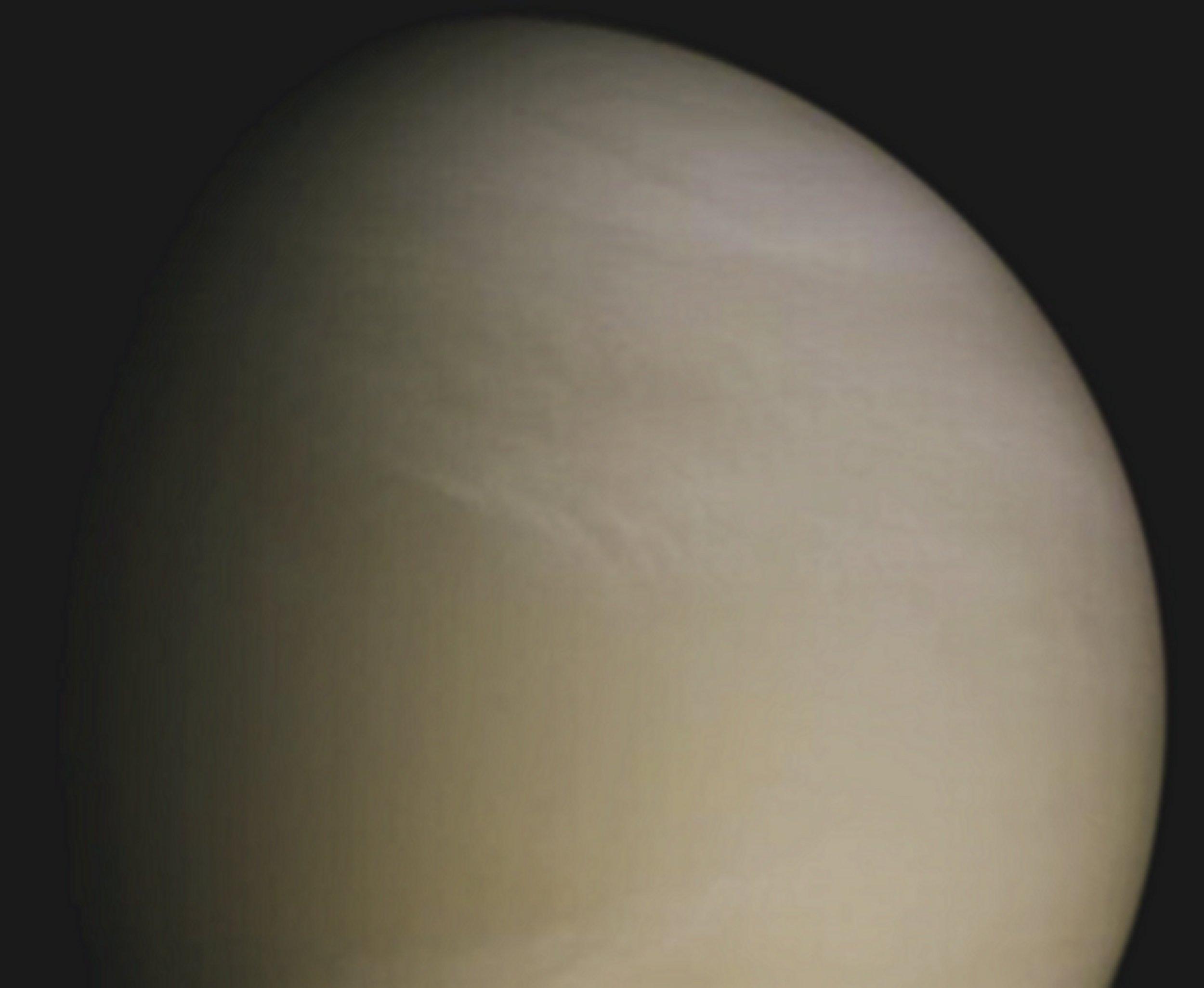
Credits: NASA/JPL/Galileo Project - Credits for the additional process. and color.: Drr Don. P. Mitchell and Paolo C. Fienga/Lunar Explorer Italia/IPF
|
Venus is the second (Inner) Planet of the Solar System; it orbits the Sun every 224,7 Earth Days, and it was named after Venus, the Roman Goddess of Love and Beauty. After the Moon, Venus is the brightest Natural Object visible in the night sky, reaching a so-called Apparent Magnitude of − 4,6 (which means that it is bright enough to cast shadows). Because Venus is a so-called "Inferior Planet" - from an Earthly point of view), it never appears (in our Sky) to venture far away from the Sun and its elongation, in fact, reaches a maximum of 47,8°. Venus reaches its maximum brightness shortly before Sunrise or shortly after Sunset, for which reason it has been known as the Morning Star or Evening Star. Venus is classified as a "Terrestrial Planet" and it is sometimes (but VERY wrongly, in our opinion) called Earth's "Sister Planet", owing to their similar size, gravity, and bulk composition. Venus is covered with an opaque layer of Highly Reflective Clouds - which are thought (better yet: seem) to be made, among others, of Sulfuric Acid - that prevent its Surface from being seen in Visible Light. Venus has the densest Atmosphere of all the Terrestrial Planets in the Solar System, and the Atmospheric Pressure at the Planet's Surface (as measured by the Soviet Probes Venera 13 and 14) is approx. 92 times that of the Earth. Venus has no Carbon Cycle to lock Carbon back into Rocks and Surface Features, nor does it seem to have any Organic Life to absorb it in biomass. It is believed that Venus, in a far distant past, might have possessed Oceans, but they (quickly?) evaporated as the Surface Temperature rose (now is up to over 400° Celsius) because of the still runaway Greenhouse Effect. The Venusian Water, therefore, has most probably "photodissociated", and, because of the lack of a strong enough Planetary Magnetic Field, the Free Hydrogen has been swept away into the Interplanetary Space by the Solar Wind. As far as we know, up to now, is that Venus' Surface is just a dry (and "burning) desert, with many slab-like Rocks, periodically refreshed by (a probably strong) Active Volcanism. This frame has been colorized in Absolute Natural Colors (such as the colors that a human eye would perceive if someone were onboard the NASA - Galileo Probe and then looked outside, towards the Planet Venus), by using an original technique created - and, in time, dramatically improved - by the Lunar Explorer Italia Team.
|
News visualized: 1023 times