

November 9, 2015

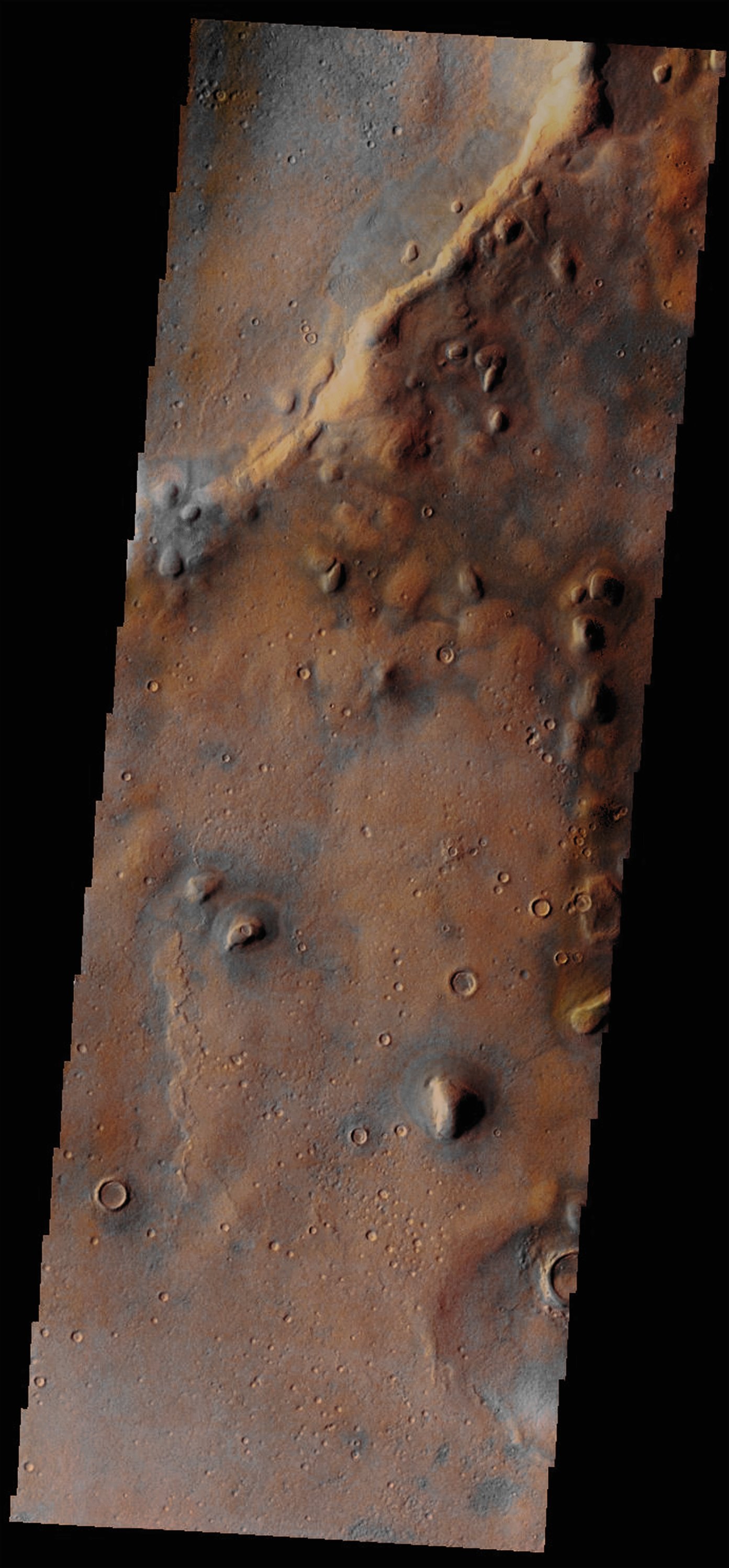
Credits: NASA/JPL/Arizona State University (ASU) - Credits for the additional process. and color.: Dr Paolo C. Fienga/Lunar Explorer Italia/IPF
|
In this interesting and, for some aspects, really controversial VIS image, taken by the NASA - Mars Odyssey Orbiter on December, 5th, 2004, and during its 13.200th orbit around the Red Planet, we can see a small part of both the Outer and Inner Rim of Tyndall Crater. Tyndall Crater is a medium-sized Impact Crater located in the Cebrenia Quadrangle of Mars, and centered at 40,0° North Latitude and 190,1° West Longitude. It is about 86,8 Km (such as roughly 53,90 miles) in diameter and it was so named after John Tyndall: a prominent 19th Century - who was born in Ireland in the AD 1820 and died, in England, in the AD 1893 - Physicist. Just out of curiosity, Tyndall Crater is located in the Martian Region known as Arcadia Plainitia and a truly interesting part of this picture is that - according to NASA's Planetary Scientists - the pale gray and orange-colored Material existing within the Impact Crater and near its Rim might have a (maybe deep) different nature and origin as to the pale gray/orangish-colored Material that is found, on the other hand, in the many Surface Depressions located outside the Crater itself. As usual: another "Martian Mistery" that needs to be solved, sometime, and in a (probably) VERY distant Future.... Latitude (centered): 39,0185° North This image (which is an Original Mars Odyssey Orbiter falsely colored and Map Projected frame published on the NASA - Planetary Photojournal with the ID n. PIA 20081) has been additionally processed, magnified to aid the visibility of the details, extra-contrast enhanced and sharpened, Gamma corrected and then re-colorized in Absolute Natural Colors (such as the colors that a normal human eye would actually perceive if someone were onboard the NASA - Mars Odyssey Orbiter and then looked down, towards the Surface of Mars), by using an original technique created - and, in time, dramatically improved - by the Lunar Explorer Italia Team. |
News visualized: 993 times