
October 14, 2015

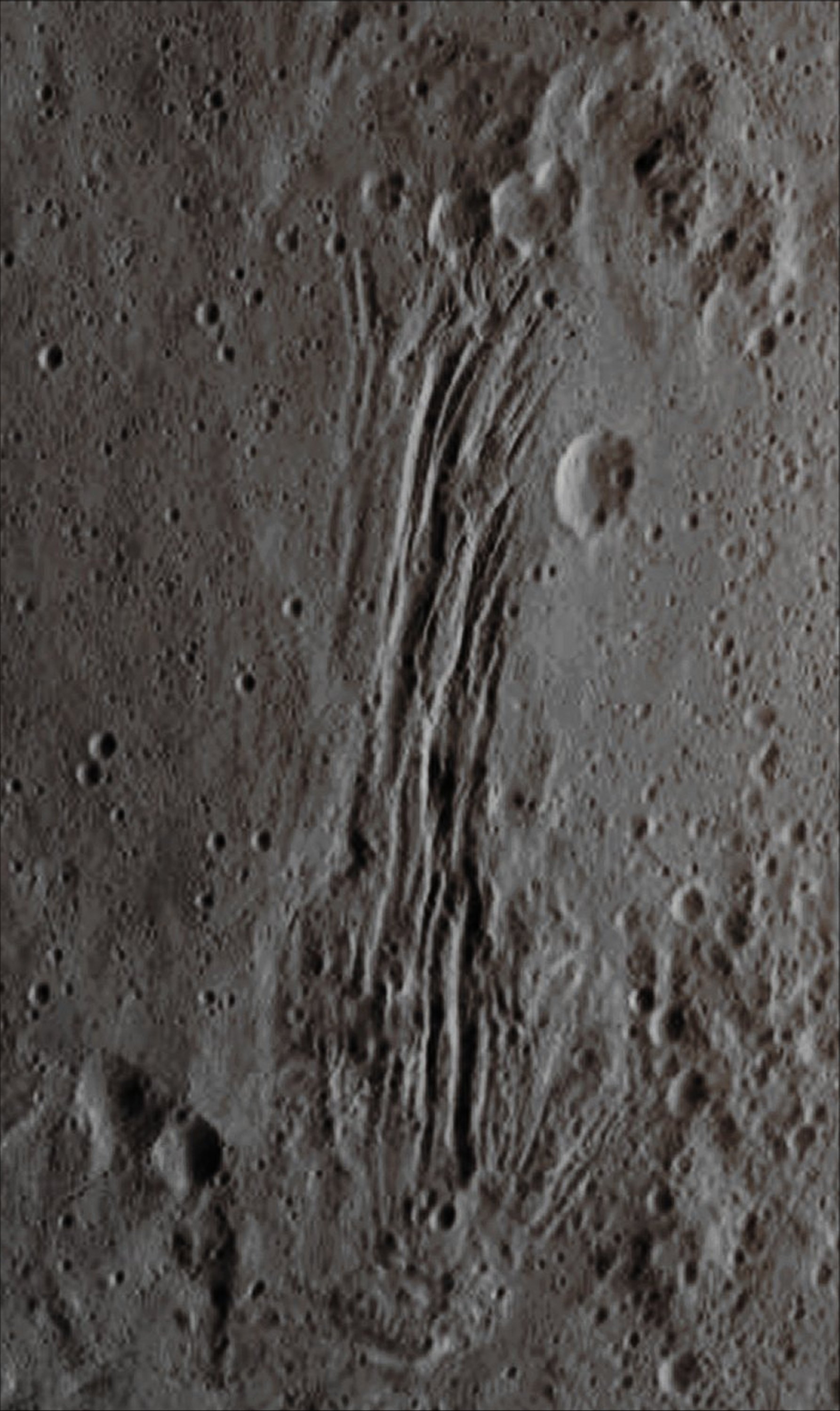
Credits: NASA/JPL-Caltech/UCLA/MPS/DLR/IDA and Dr Paolo C. Fienga for the additional process. and color.
|
This is another Extra Detail Magnification ("EDM") obtained from a very interesting Contextual (or "CTX", for short) Frame, taken by the NASA - Dawn Spacecraft on September, 15, 2015, which showed us several intriguing Surface Features that are all located of the Dwarf Planet known as 1-Ceres. Here we can see some unusually-looking and relatively deep Surface Striations which miy either look like Channels or, maybe, like medium-sized Semi-Parallel Canyons. Their origin is, so far, unknown, but it is possible that these Features could be the visual evidence of a series of Impacts (most likely occurred at the very same time - or, maybe, in an extremely short lap of time) where the Impactors, before ending their course, "rolled over" the Surface for a while and caused these deep Striations that we can see here. Of course, this is just a possibility and nothing more than a speculation. You may want to notice the the Striations, looking to the North, end up near or even within a few Unnamed Impact Craters, while in their way to the South they seem to end up by forming a huge Landslide-shaped Surface Feature. The photo was taken from an altitude of approx. 915 miles (such as about 1472,5461 Km) from the Surface, with a resolution of roughly 450 feet (such as about 137,16 meters) per pixel. This image (which is a crop obtained from an Original NASA - Dawn Spacecraft's b/w and NON Map-Projected frame published on the NASA - Planetary Photojournal with the ID n. PIA 19972 - Dawn HAMO Image 34) has been additionally processed, extra-magnified to aid the visibility of the details, contrast enhanced and sharpened, Gamma corrected and then colorized (according to an educated guess carried out by Dr Paolo C. Fienga-LXTT-IPF) in Absolute Natural Colors (such as the colors that a normal human eye would actually perceive if someone were onboard the NASA - Dawn Spacecraft and then looked ahead, towards the Surface of 1-Ceres), by using an original technique created - and, in time, dramatically improved - by the Lunar Explorer Italia Team. |
News visualized: 793 times