

April 27, 2012

Credits: Soviet Space Agency - Credits for the additional process. and color.: Dr Marco Faccin/Lunar Explorer Italia/IPF
|
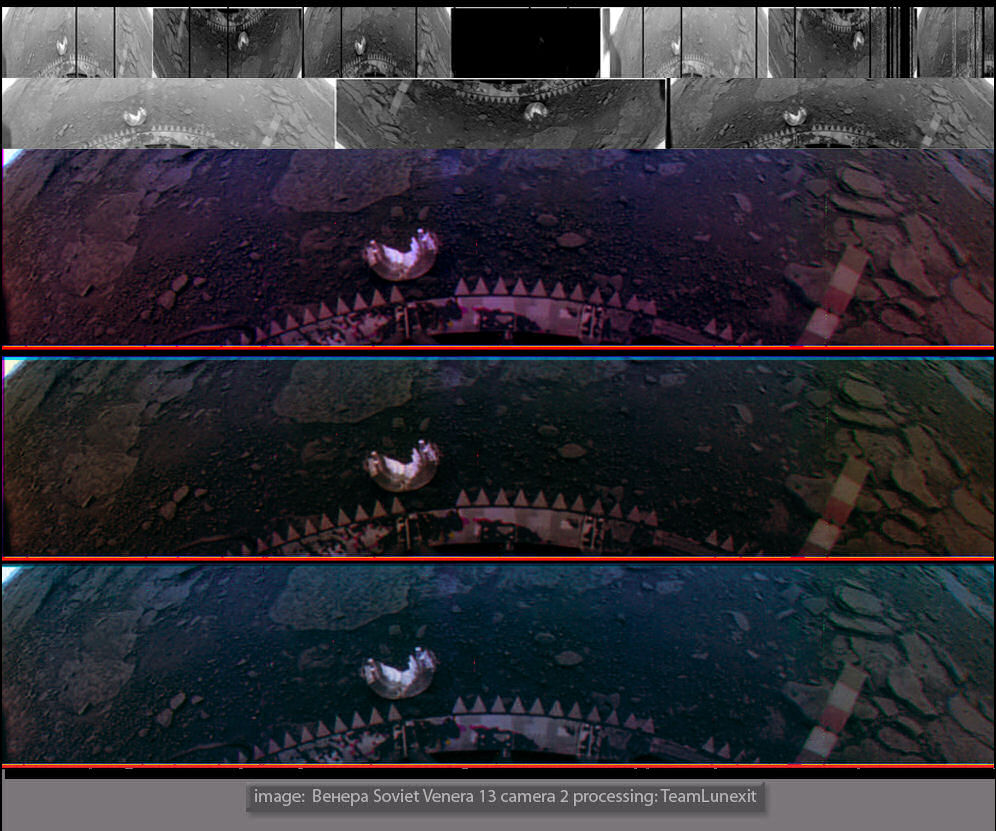
The Venera 13 was a Soviet Spacecraft conceived and utilized during the so-called "Venera Program", such as the Soviet Campaign related to the exploration of the Planet Venus. Venera 13 was launched on October, 30th, 1981 (while its twin, Venera 14, took off on November, 4th,1981), with an on-orbit Dry Mass of 760 Kg. Both Venera 13 and 14 consisted of a Bus and an attached Descent Craft; the Descent Craft (or Lander) was an hermetically sealed and pressurized vessel, which contained most of the Instrumentation and Electronics, mounted on a ring-shaped Landing Platform and topped by an Antenna. The design was similar to the earlier Venera 9 - 12 Landers and it carried several scientific instruments which were put onboard in order to take Chemical and Isotopic Measurements, monitor the Spectrum of Scattered Sunlight (and, just out of curiosity, we remind you that the Venusian Atmosphere DOES NOT scatter Blue Light) and record Electric Discharges (such as Lightnings), if any, during its Descent Phase. The Spacecraft utilized a Camera System, an X-Ray Fluorescence Spectrometer, a Screw Drill and Surface Sampler, a Dynamic Penetrometer, and a Seismometer to conduct a few investigations during the (relatively short) time that the Lander would have stayed (better to say "resisted") on the Surface. After launch and a 4 (four) month cruise to Venus, the Descent Vehicle separated from the Bus and plunged into the Venusian Atmosphere on March 1st, 1982. After entering the Atmosphere, a parachute was deployed. At an altitude of about 50 Km, the parachute was released and simple airbraking was used for the rest of the way to the Surface. Venera 13 landed at 7° and 30' South Lat. and 303° and 00' East Long. (about 950 Km North/East of Venera 14, and just East of an elevated Venusian Region known as Phoebe Regio). The Lander had cameras to take pictures of the surrounding Surface and spring-loaded Arms to measure the compressibility of the Soil. The quartz camera windows were covered by lens caps, which popped off after the end of the descent. The area where the Venera 13 landed (and that we believe, as IPF, was close to the edge of a Scarp) was composed of Basaltic Outcrops surrounded by Dark, Fine-Grained Soil. Right after landing, an imaging panorama was started and a Mechanical Drilling Arm reached on to the Surface and obtained a sample, which was deposited in a hermetically sealed chamber, maintained at 30° C - with a pressure of about 0,05 Atmospheres - and summarily analyzed. The composition of the sample, as determined by the X-Ray Fluorescence Spectrometer, put it in the class of the Weakly Differentiated Melanocratic Alkaline Gabbroids (such as just one of the many existing varieties of Basalt). The Lander survived for 2 hours and 7 minutes (a very remarkable result, if you consider that the original "Life Span" of the Lander was of only about 32 minutes!) in an extremely hostile environment, with a Surface Temperature of 457° C (such as 855 F) and a pressure equal to 89 Earth Atmospheres. The Descent Vehicle transmitted the collected information to the Bus, which acted as a Data Relay as it flew by Venus. |
News visualized: 1131 times