

April 21, 2012

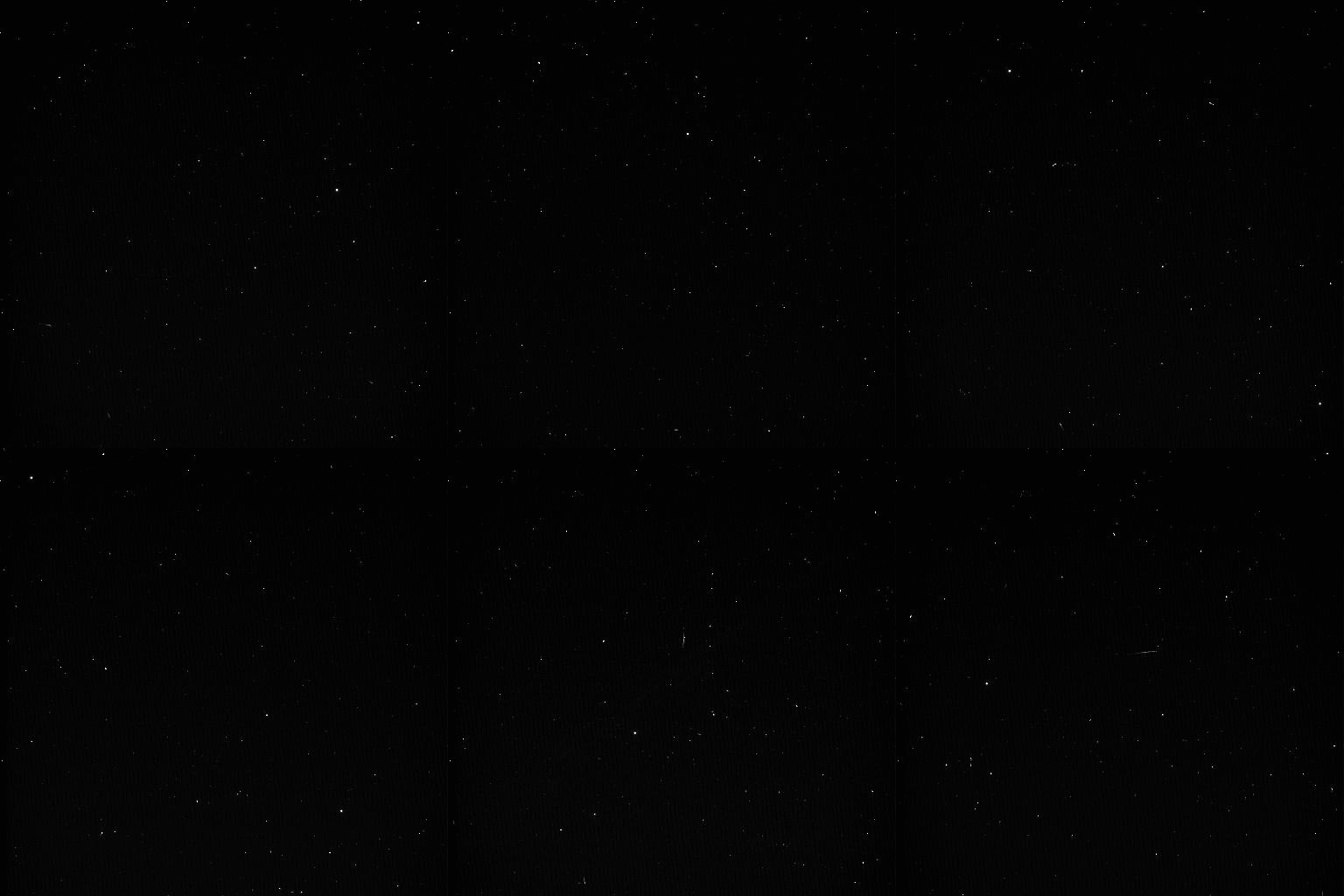
Credits: NASA/JPL/Space Science Institute - Credits for the additional process.: Elisabetta Bonora/Lunar Explorer Italia/IPF
|
Even with today's APOD we have decided to remain in the Space of Saturn (which is always interesting to explore) and we wish to offer you a short GIF-Movie showing the small moon Albiorix (also named Saturn XXVI) rapidly passing by in front of the NASA - CASSINI Spacecraft cameras. Albiorix, which is a Prograde Irregular Satellite of the Ringed Giant Gas Planet, was discovered by the Smithsonian Astrophysicist and Lecturer at the Harvard University, Dr Matthew J. Holman, et al. in the AD 2000, when it was given the temporary designation of S/2000-S11. Albiorix is the largest member of the so-called Gallic Group (which is formed, with Albiorix, by the small moons Bebhionn, Erriapus and Tarvos) of the Saturnian Irregular Satellites and it was so named (in August 2003) after "...a Gallic Giant who was considered to be the King of the World...". The name Albiorix is known from an inscription found near the French town of Sablet which apparently identifies him with the Roman God, Mars (this according to an interpretatio romana). Albiorix orbits Saturn at an average distance of about 16 Million Km (MKM), and its diameter is estimated to be about 32 Km. The Rotation Period of Albiorix was measured by the ISS camera onboard the NASA - CASSINI Spacecraft, and it has been found equal to 13 hours and 19 minutes. Given the substantial similarity of the Orbital Elements and the homogeneity of the apparent Physical Characteristics of Albiorix with the other three members of the Gallic Group, it was suggested that these small Group of moons could have a common origin, perhaps to be found in the break-up of a larger moon. However, the varying colours (even though it would be better to say "the varying shades" of gray that seem to characterize the Albedo Changings) of this moon, as it was very recently revealed, also suggested the possibility of the presence of a large Impact Crater on Albiorix: a fact, this one, that, if (and when) proven true, could logically lead to an alternative hypothesis about the origin of at least three of the four Gallic Moons, such as that Erriapus and Tarvos could actually be just fragments of Albiorix. Fragments that followed a near-break-up collision of Albiorix itself with another (and of course unknown) Celestial Body (maybe, we suggest, a wandering Asteroid or a small Comet). |
News visualized: 910 times