April 20, 2012

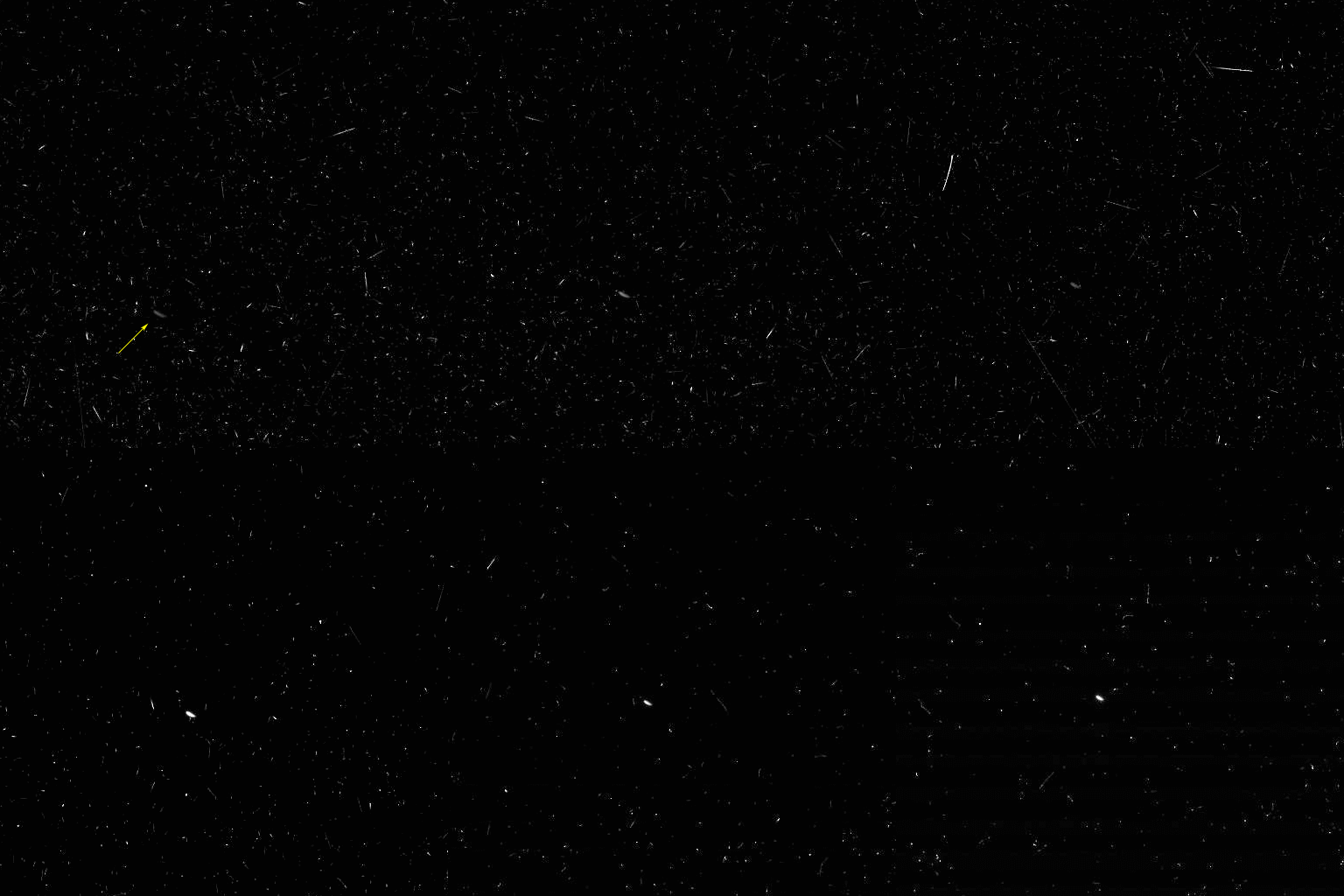
Credits: NASA/JPL/Space Science Institute - Credits for the additional process.: Elisabetta Bonora/Lunar Explorer Italia/IPF
|
Aegaeon, or also Saturn LIII (being its provisional designation S/2008-S-1), is one of the very many Minor Moons of Saturn. Its discovery was first announced by Dr Carolyn Porco, of the Cassini Imaging Science Team, on March 3, 2009, from observations taken on August, 15, 2008. Aegaeon orbits within the bright segment of Saturn's G-Ring, and it is, very likely, a Major Source of (the Material - such as small Rocks and Dust - forming) the Ring itself. Debris knocked off this moonlet form a bright Arc near the Inner Edge of the G-Ring, which afterwards spreads up and then concur to form the rest of the Ring. This very small moon is "trapped" in a 7:6 Co-Rotation Eccentricity Resonance with Mimas. Aegaeon, Anthe and Methone, therefore, altogether form a distinctive Class of Objects in the Saturnian Moon System, such as: Small Moons in co-rotation Eccentricity Resonances with Mimas and associated with (bright) "Arcs of Debris". Comparisons among these different Ring-Arc Systems revealed that Aegaeon’s orbit is much closer to the exact Resonance than Anthe’s and Methone’s orbits are and this fact could indicate that Aegaeon has undergone a significant Orbital Evolution via its interactions with the other objects present in its Arc's Segment (which would be consistent with the evidence that Aegaeon’s mass is way smaller relative to the total mass in its Arc than Anthe’s and Methone’s masses are). Assuming that Aegaeon has the same Albedo as Pallene, his size can be estimated to be only about half a kilometer (such as approx. 500 mt) in diameter. This Saturnian moonlet has been named after Aegaeon, who was one of the so-called "Hecatonchires" (in Greek Language or "Centimani", in Latin). The Hecatonchires were three giants of incredible strength and ferocity, even superior to that of the Titans whom they helped overthrow (remember that their name derives from the Greek words "hekaton" ---> "hundred" and "kheir" ---> "hand"); each one of them had a hundred hands and fifty heads. Hesiod's Theogony (624, 639, 714, 734–35) reports that the three Hecatonchires became the guards of the Gates of the Tartarus which, in Greek Mithology, it is a deep and gloomy place - a pit, or an abyss - used as a dungeon of torment and suffering that resides beneath the underworld. In other words, we are talking about an Hell deeper and darker than the "Traditional" Hell... Additional Technical Notes: the so-called Orbital Eccentricity of a Celestial Body is nothing else but the amount by which its orbit deviates from a perfect circle: at this point, consider that 0 - zero - Orbital Eccentricity means a perfectly circular orbit while 1.0 Orbital Eccentricity means a parabola, and therefore a no longer "Closed Orbit"; on the other hand, the so-called Orbital Resonance means, in Celestial Mechanics, a particular Gravitational Relationship between two (or more) orbiting Celestial Bodies that is fit to make them exert a regular and periodic Gravitational Influence over each/one other. In this GIF-Movie, jointly with the banana-shaped Minor Saturnian moon (actually, a "moonlet") Aegaeon (whose Albedo changes very rapidly - a circumstance that is due, we believe, to its peculiar motion and rotation and the subsequent change of the Illumination Geometry between its Surface and the Sunlight), we can also see traces of "noise" (which is the cause of a peculiar type of image-artifacts), Streaks of Light from Cosmic Rays and, probably (but we are NOT sure of this) a few distant Stars. |
News visualized: 832 times