

April 18, 2012

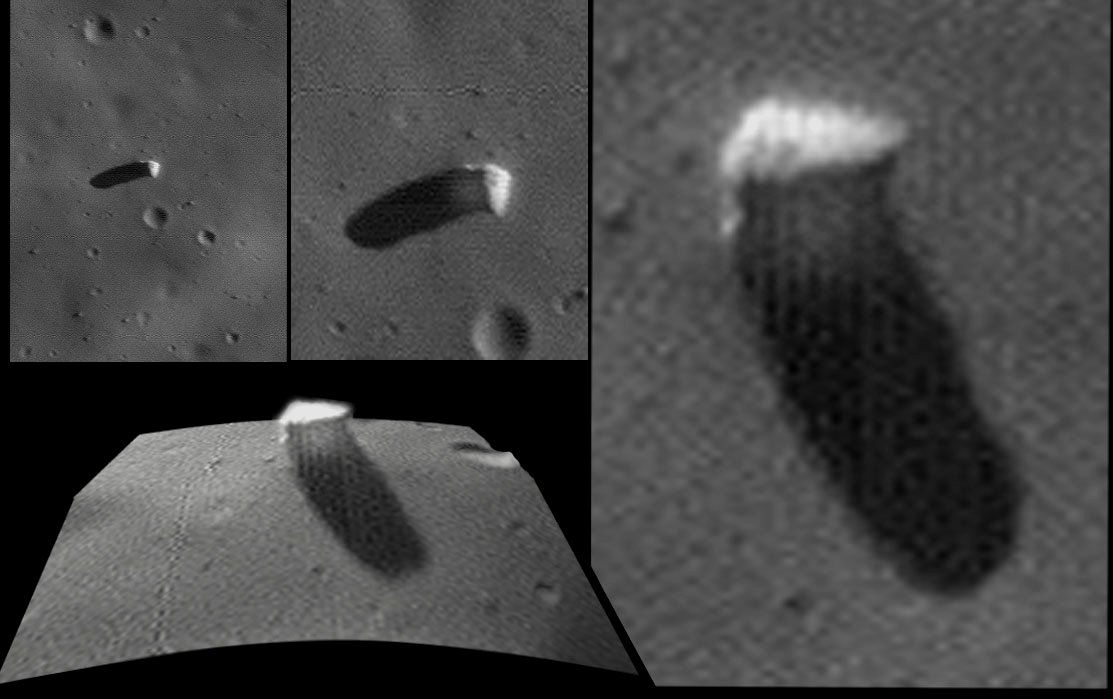
Credits: NASA/JPL/MSSS - Mars Global Surveyor Mission - Credits for the additional process.: Dr Marco Faccin/Lunar Explorer Italia/IPF
|
Since our daily APOD has suddenly (actually, for about three days only...) become "famous" on the www, thanks to a small piece of information that talked, among other things, about the so-called "Phobos' Monolith", we have decided to publish today, for both our Old and New Friends, another series of frames, all showing us, from different angles and altitudes, this however interesting Surface Feature. For those who have missed our previous publication (dated January, 23rd, 2012) about this alleged anomaly, we repeat what we have already said and written many times, such as that all we are looking at, here, is just a Rocky Outcrop or, if you prefer, a Columnar-shaped Erratic Boulder, whose outline can vaguely remind us of an Irregular Triangle. A "Triangle" that shows a Dark Diagonal Crack near its base and another Fracture at about half of its height, better visible on the left side of the Feature. The upper portion of the Boulder, then, shows clear irregularities (one or more sort of "bumps" can easily be seen on its upper left corner), while other minor (but still perfectly visible) irregularities can be identified all over it. Its Albedo, however, tells us that the Feature is likely made of a Rocky Material that is strongly different from the other Material (mostly Regolith) that we can see all over its surroundings, an this FACT, in our humble opinion, is the "REAL" (and the ONLY) anomalous aspect of such a Surface Feature. As a matter of fact, and in the end, once we have taken into duly account both its shape and high Albedo, we can reasonably believe that this Surface Feature could either be a Fragment of a Meteor that impacted Phobos in a very distant past, or an Ejecta Boulder, such as a fragment of Phobos itself that, after the occurrence of a powerful Meteor Strike, was thrown away from some other (and even distant) place of Phobos, and, probably lacking the right momentum, instead of getting dispersed in space, fell back down on Phobos, here, where we see it now and where we shall see it for the eons and eons to come. We also wish to thank so very much the "Corriere della Sera" for having mentioned the Lunar Explorer Italia Foundation in their piece of information. |
News visualized: 3270 times