

April 16, 2012

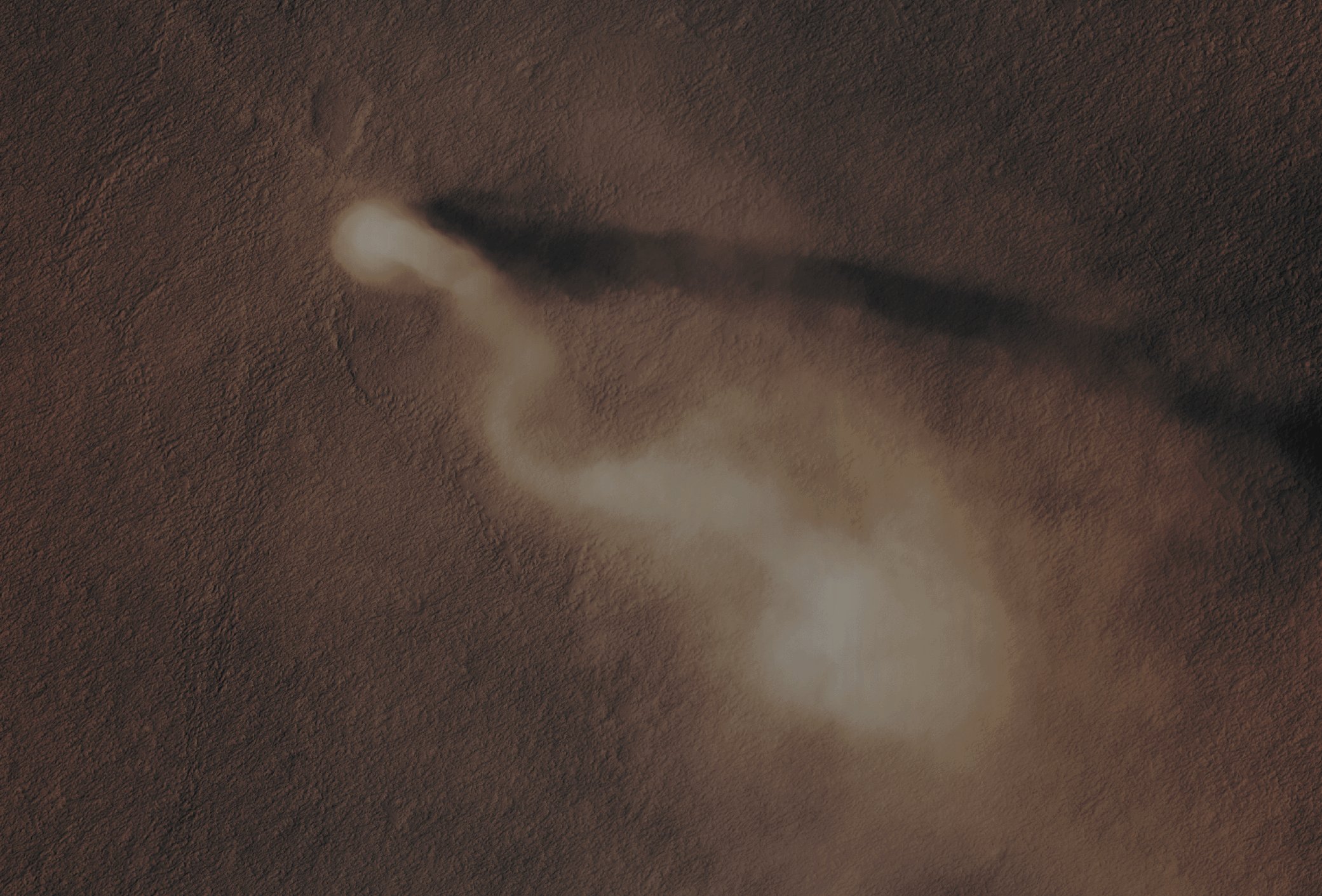
Credits: NASA/JPL/University of Arizona - Credits for the additional process. and color.: Dr Paolo C. Fienga/Lunar Explorer Italia/IPF
|
Another (and this time litterally gigantic) Dust Devil, roughly the size of a Terrestrial Tornado, towers above the Martian Surface at Amazonis Planitia, in this Late Springtime afternoon image of this Region. Also captured by the Context Camera onboard the NASA - Mars Reconnaissance Orbiter (or MRO, for short), the length of the shadow indicates that the Dust Plume reached an height of about 20 Km (approx. 12 miles) above the Surface. However, and despite its gargantuan height, the Plume is only 70 meters (70 yards) in diameter and, since it has been twisted by High Altitude Winds, it gave the Dust Devil a snake-like appearance, similar to that of another Dust Devil which was recently caught in the act, in this very same Region of Mars. Typical Tornadoes on Earth are usually less than 10 miles tall, while Dust Devils on our Home Planet seldom reach more than a few hundred yards in height. So, why do we classify this Plume as a "Monster Dust Devil" and not a Martian Tornado? That is because Dust Devils differ from Tornadoes in their Energy Sources: as a matter of fact, Dust Devils are driven by the Heat of the Surface they move on, absorbed from Sunlight and re-radiated to warm the Atmosphere. The warm Air rises and spins as it contracts, much as a figure skater spins faster as she draws her arms to her sides. The astounding heights of Martian Dust Devils are made possible because the mass of an Atmospheric Column on Mars is less than 1% (one-percent) than that of an Atmospheric Column on Earth. Transfer of Heat from the Surface into this less dense Atmosphere can produce more vigorous convection, which will penetrate higher into the Martian Atmosphere than its counterparts do on Earth. Now, what would happen if an Astronaut were caught in its path? Because the density of Mars' Atmosphere is very low, even a high velocity Dust Devil is unlikely to knock the Astronaut over. However, he (or she) might be blasted by any Sand or Dust Particles carried along by the Dust Devil: an unfortunate event which might either scratch, or even damage way more seriously, both the Visor of the Space Suit itself pretty quickly. This specific Vortex left behind a Bright Track as its Winds disturbed the Dust-covered Surface of Amazonis Planitia, tracing the Path of the Dust Devil (which is coming from the North/West and heading towards the South/East). A Dust "Skirt" twice as wide as the Plume itself can be seen near the base of the Dust Devil, but the Bright Track is the size of the Plume and not the one of the Skirt. Out of curiosity, we want to underline that dozens of smaller Dust Devils were also spotted in the same Context Camera scene, while they were steadily vacuuming the Martian Surface and "pumping" Dust up into the Martian Atmosphere. Mars Local Time: 15:02 (Early Afternoon) This frame has been colorized in Absolute Natural Colors by (such as the colors that a human eye would actually perceive if someone were onboard the NASA - Mars Reconnaissance Orbiter and then looked down, towards the Surface of Amazonis Planitia - Mars), by using an original technique created - and, in time, dramatically improved - by the Lunar Explorer Italia Team.
|
News visualized: 2118 times