


April 15, 2012

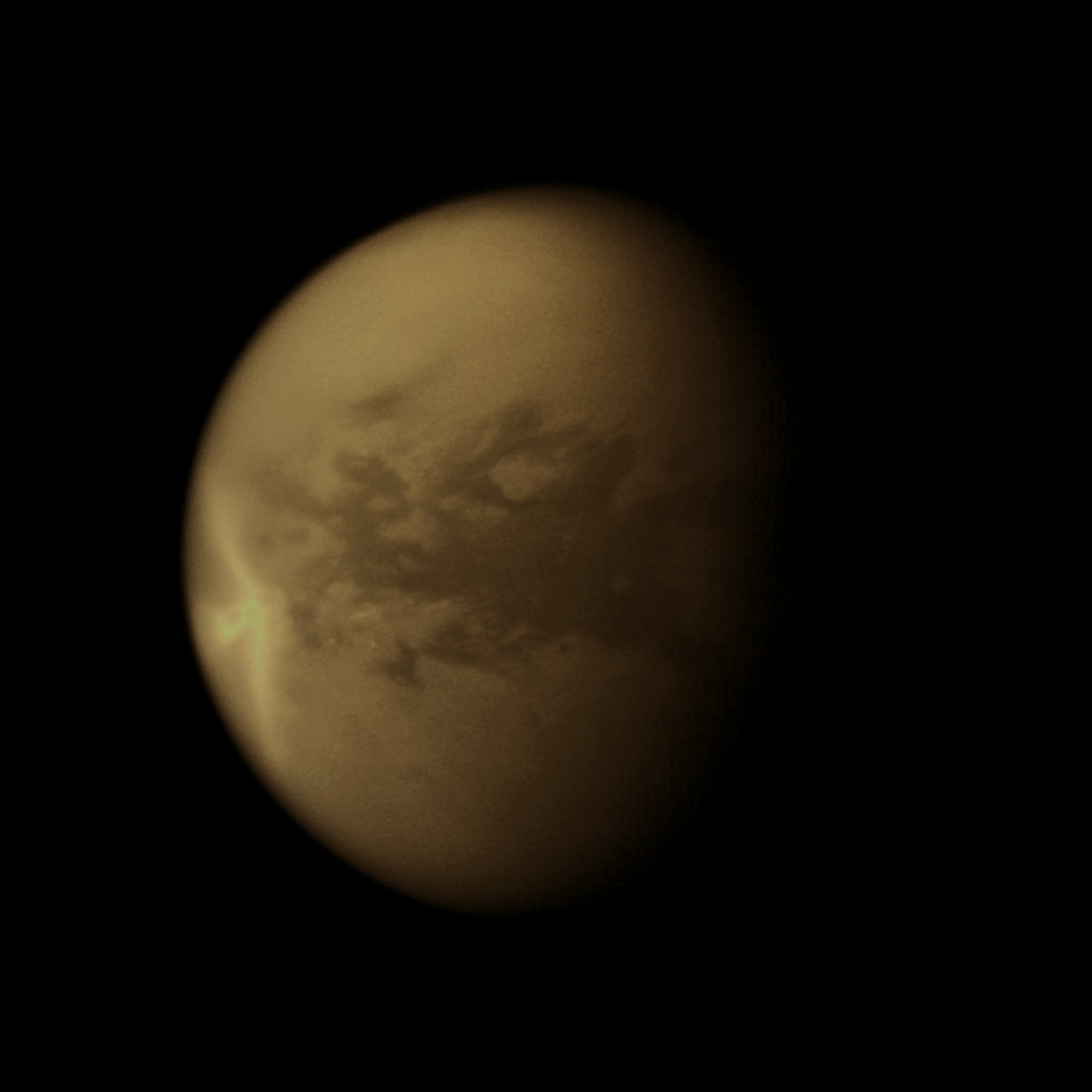
Credits: NASA/JPL/Space Science Institute - Credits for the additional process. and color.: Dr Paolo C. Fienga/Lunar Explorer Italia/IPF
|
A huge arrow-shaped Storm blows across the Equatorial Regions of Titan, as it can be clearly seen in this image taken by the NASA's Cassini Spacecraft, and chronicling the Seasonal Weather Changes on Saturn's largest moon. This Storm might have created large effects on the Surface of Titan, likely in the form of dark pools and floods, as better visible in later images. After this Storm dissipated, Cassini observed significant changes on Titan's Surface at the Southern Boundary of the large Dunefield named Belet. Those changes covered an area of approx. 500.000 square Km (such as about 310.500 square miles), or roughly the combined area of Arizona and Utah in the United States. The part of the Storm that is visible here measures approx. 1200 Km (such as 745,2 miles) in length East-to-West. The wings of the Storm that trail off to the North/West and South/West from the Easternmost point of the Storm itself and each of them is approx. 1500 Km (931,5 miles) long. This frame has been colorized in Absolute Natural Colors (such as the colors that a human eye would actually perceive if someone were onboard the NASA - Cassini Spacecraft and then looked outside, towards the Saturnian moon Titan), by using an original technique created - and, in time, dramatically improved - by the Lunar Explorer Italia Team.
|
News visualized: 1084 times