
April 12, 2012

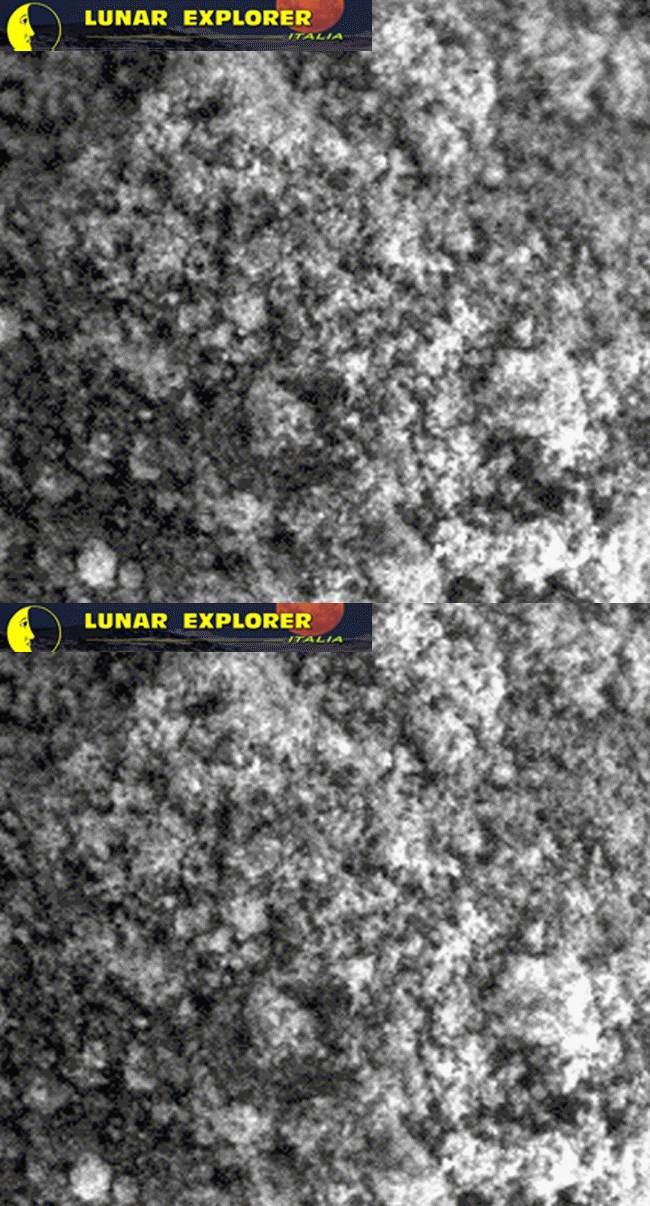
Credits: NASA/JPL/Cornell/USGS - MER Spirit - Credits for the additional process.: Dr Gianluigi Barca/Lunar Explorer Italia/IPF
|
Is there Life on Mars? As you can easily imagine, that is not only a beautiful (and a little dated...) song from the rockstar David Bowie, but it is a question that every real and intellectually honest Scientist and/or Public Researcher should (actually MUST) ask himself every time pictures and science data from the Red Planet are received and studied. Sure, the question is tricky and, as a matter of fact, it is also almost impossible to answer with certainty. But we do have now, after decades of unmanned exploration, several elements to evaluate; we have thousands of pictures, and, once we put everything together, we find, inevitably, many controversial issues to face and to (try to) interpret. One thing (among MANY others!) that we, as IPF, in time have (sadly) noticed, is that the Scientific Community does not like to discuss certain subjects. Actually, the truth is, in our opinion, that the Scientific Community does not like to question itself, never and no matter what. Sometimes it is like the Scientists were afraid to say "we do not know". Yes, we agree: there are many times when to say "I do not know" it is hard, unrewarding and, most of all, probably extremely embarassing and frustrating. But the fact is that there still are thousands of things that we DO NOT know, and the sooner we accept this simple truth, the faster Science (the real Science) shall start walking again, towards new horizons. Maybe unexpected ones: who knows... Aside from the Scientific Community, there are the so-called "Private Researchers" (like us) which, since they are free from certain (unwritten, and yet binding: terribly binding) rules and regulations, try to do the same work that Scientists and Public Researchers do, but by using a different, and way more open, approach. We make mistakes, many times, because we do not have neither the means and information, nor the experience and expertise of our Colleagues that work for Universities, Space Agencies, or Governments. But this does not mean that we are incapable of putting data together. Actually, we believe that we are (better yet: we have become, in time) quite good at putting things together, and one proof is that our work, a few times (many times, actually...), has been used by our aforementioned Colleagues, so that they could either start, or substantiate some of their ideas and hypotheses. They "forgot" to mention our contribution to their work, unfortunately, but it does not matter, because we know that, sometimes, it is not only hard to say "I do not know", but it is even harder to say "thank you"...But this is Life, and so we go on, searching, finding and analyzing, with the hope that, some day, even our hard work might - in a way or another - be rewarded. Is there Life on Mars? We think so. We think that, after aeveral years of data collection and subsequent analyses, it is almost impossible to get to a different conclusion than this one (which is not final, of course, but it certainly is in an advanced state of progress). We believe, as IPF, that on the Surface of Mars and, likely, under it, there are Indigenous Lifeforms which, once again, defy the "solid conclusions" that our Science is based on and that its loyal Servants keep repeating and repeating, such as that Mars is a cold, deserted and dead place. A place where no Earth-like Lifeforms can survive nor develop. But the point is that we agree on that! Earth-like Lifeforms cannot survive on Mars, as it is now. But why do we always have to think about Earth-like Lifeforms? Let's not forget that, on Mars, we are supposed to find, if any, Lifeforms other than Terrestrial. Lifeforms that are fit to survive in a deeply different environment. Lifeforms that have no connection with Earth, because they were born on Mars: is this concept so hard to understand?!? Mars is Mars, Earth is Earth, Enceladus is Enceladus and so forth: different places, different environments, different - VERY DIFFERENT, most likely - Lifeforms. That is it. In the future, we shall discuss in a deeper way this subject, which is controversial by definition. But for now, let us just say that, if we really want to grow a little bit, both as humans as well as Researchers, we have to start thinking a little bit "outside the box", if we really want to find answers. The Earth, our beautiful Home Planet, is the "box", and if we want to begin to understand a little more about what can really be found outside, elsewhere in the Solar System (for starters...), we MUST try to think differently. We MUST try to analyze data differently. We MUST try to look for different explanations and scenarios. Maybe, at the end of our quest, we shall remain with our hands empty: sure, this is a possibility! But what chances do we have to learn more, if we do not even try?!? Think about it... |
News visualized: 899 times