
April 10, 2012

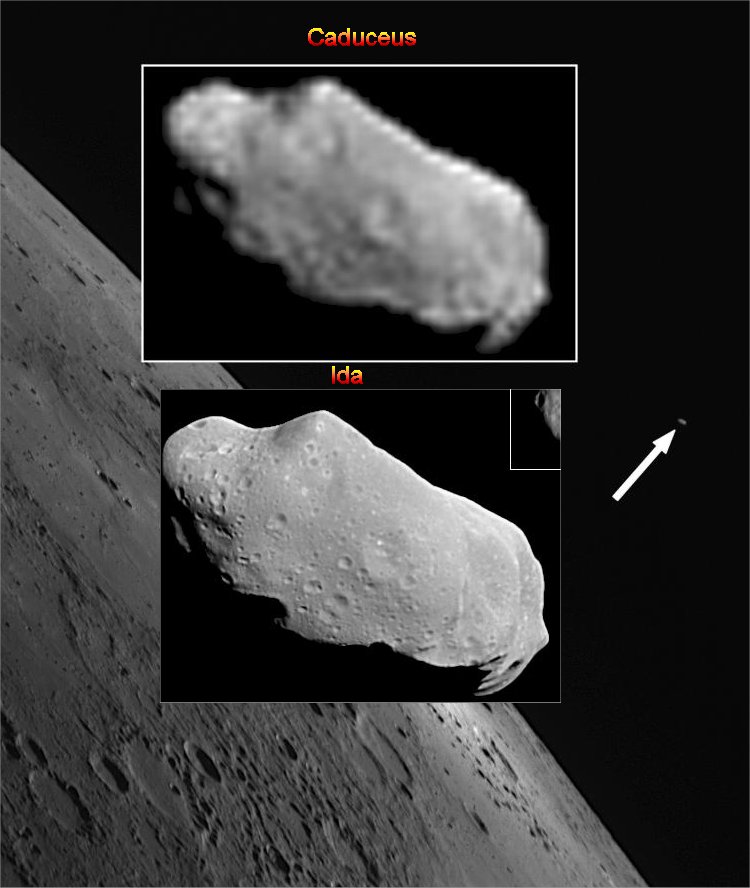
Credits: NASA/USGS - Johns Hopkins University Applied Physics Laboratory/Carnegie Institution of Washington and Dr Paolo C. Fienga for the research
|
When we have seen the first frame representing the newly discovered Mercurian moon Caduceus (whose name is still under approval by the International Astronomical Union - IAU), we have thought that our NASA Friends had made a big mistake when publishing its picture in their NASA/JPL Photojournal (see image PIA15542, entitled "Mooning Mercury"). Why a mistake? Well, we suggest you to see and make sure of this fact for yourself: Caduceus is WAY MORE than similar to the Asteroid known as 243 Ida and, actually, it seems to us, as IPF, that the two Celestial Bodies are almost identical (exception made for their dimensions, since Asteroid 243 Ida is way bigger than the "little" Caduceus). Look, for instance, at their (potato-like) shapes and outlines, and then check also a few of their more visible Surface Features: even some ancient Surface Depressions, Slopes and Impact Craters appear to be located in the same spots, roughly (and considering the pictures and data in our possession) at the same coordinates. Id does not take a Scientist or an extremely sharp-sighted individual to see, just after one quick look, the impressive (and, in a way, kind of disturbing...) similarity existing between Caduceus and 243 Ida. So, are these two Celestial Bodies, somehow, "related"? Or are we just looking at an almost unbelievable coincidence (maybe determined, among others, by the specific spatial configuration that the two Celestial Bodies assumed in the two pictures)? Of course, a final and well sustantiated answer to this question cannot be given for now. And certainly it cannot be given by us. We just wanted you to notice that, for reasons that are still very far away from being understood by our own (some say "infallible"...) Science, there are events and objects (in our Solar System as well as elsewhere outside it) that seem to defy our Logic and Understanding of the Cosmos. Which means, in other words, that the Journey of our Knowledge, as far as the Universe is concerned, is just beginning... Note 1: the picture of 243 Ida was taken by the Imaging System onboard the NASA - Galileo Spacecraft about 14 minutes before its closest approach to the Asteroid (closest approach that occurred on the date of August 28, 1993). The approximate dimensions of 243 Ida are 53 x 24 x 15 Km; the range (such as the distance of the Asteroid) from the Spacecraft was, at the time the picture was taken, of about 10.500 Km (approx. 6500 miles). A Natural Color picture of this Asteroid 243 Ida would make it appear mostly gray to normal human eyes. However, shadings in this image indicate changes in the so-called Illumination Angle (changes that are caused by the many steep slopes existing on this irregular body) as well as subtle gray-color variations are due to differences in the physical state and composition of its Soil. On the other hand, the image providing the first evidence that Mercury has a small Natural Satellite (or moon) was taken by the NASA - MESSENGER Spacecraft by its Mercury Dual Imaging System (MDIS) Wide Angle Camera (WAC); Caduceus is only and approximately 70 meters (230 feet) in diameter and orbits Mercury at a mean distance of 14.300 Km (such as approx. 8890 miles). Note 2: this whole "Caduceus" thing was just a joke, conceived and put into effect by the Messenger Team in occasion of April Fools' Day. Congratulations: we bought it! But...this is another way to prove (beyond any reasonable doubt) that IF you have the skills and means (and REPUTATION!), you can EASILY add - or remove - visual information (---> Features) from any RAW-image data coming from Space. Useless to say (but we say it anyway), the implications of such a circumstance (better yet: possibility!), if you think about it, are, in fact, REALLY disturbing... |
News visualized: 930 times