


January 22, 2015

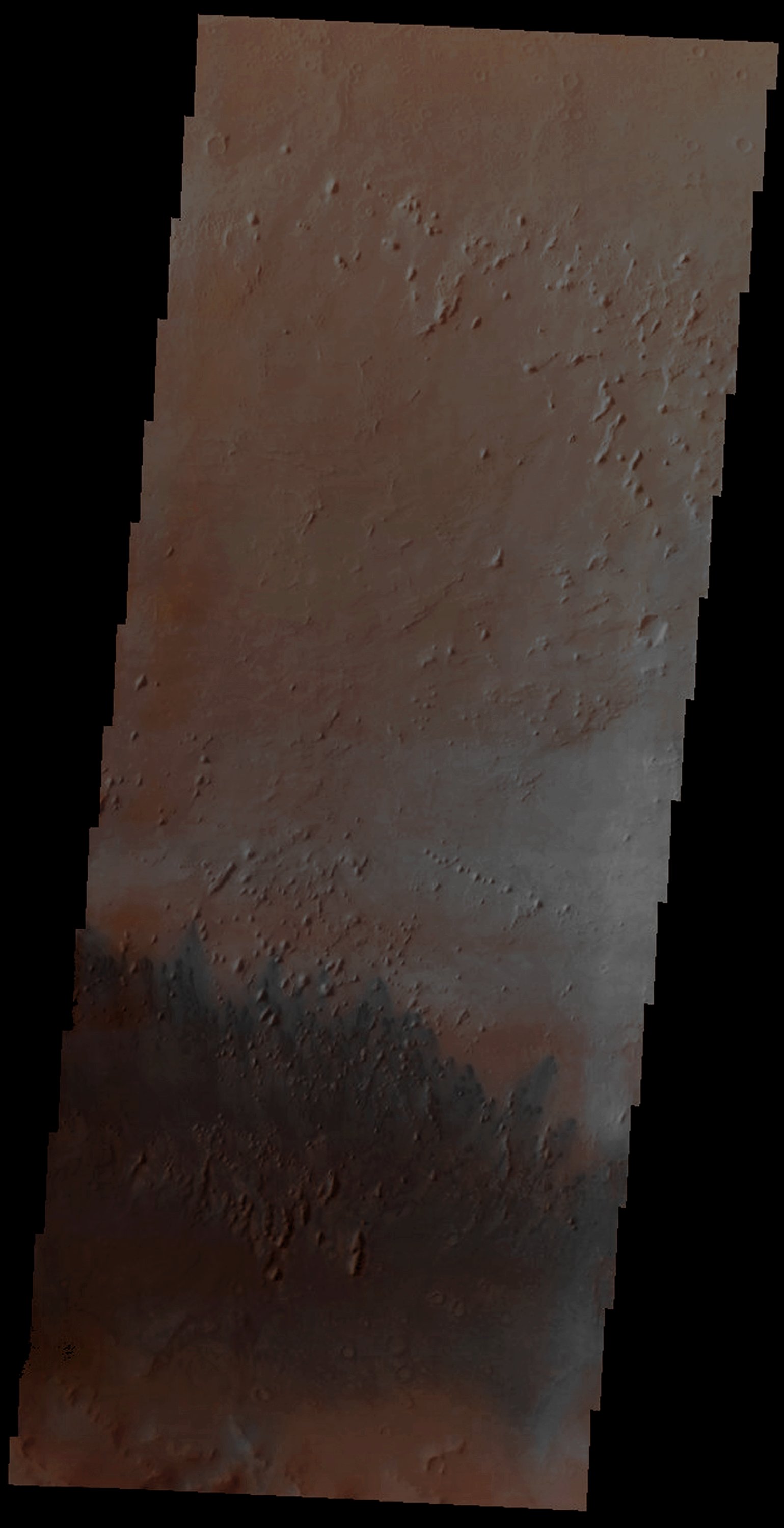
Credits: NASA/JPL/Arizona State University (ASU) - Credits for the additional process. and color.: Dr Paolo C. Fienga/Lunar Explorer Italia/IPF
|
In this VIS image, taken by the NASA - Mars Odyssey Orbiter on October, 3rdh, 2002, and during its 3.557th orbit around the Red Planet, we can see a very small section of the relatively flat Floor of an Impact Crater named Capen Crater (after the American Astronomer Charles F. Capen, who was born at Gilman, Illinois - USA - on January 1st, 1926, and died in his home at Cuba, Missouri - USA - on May, 28, 1986, after an extremely acute, and therefore lethal, asthmatic attack) and located in the ancient peri-Equatorial Martian Region known as Arabia Terra. Capen Crater is approx. 70 Km (such as about 43,47 miles) in diameter and it is about 10° North of the very well-known Schiaparelli Crater. Even in this case, there is a strong color contrast between the Area of Capen Crater located to the North (top of the frame) and the one visible to the South; however, a true and definitive reason of such a color difference - besides the existence of a deeply different Mineralogy of the Floor of Capen Crater between these two Areas - cannot be given yet. In any case, an Aeolian Factor, in our opinion, as IPF, cannot be ruled out at this moment. Latitude (centered): 6,47981° North This image (which is an Original Mars Odyssey Orbiter false colors and Map-Projected frame published on the NASA - Planetary Photojournal with the ID n. PIA 19022) has been additionally processed, magnified to aid the visibility of the details, contrast enhanced and sharpened, Gamma corrected and then re-colorized in Absolute Natural Colors (such as the colors that a normal human eye would actually perceive if someone were onboard the NASA - Mars Odyssey Orbiter and then looked down, towards the Surface of Mars), by using an original technique created - and, in time, dramatically improved - by the Lunar Explorer Italia Team. |
News visualized: 851 times