


March 24, 2012

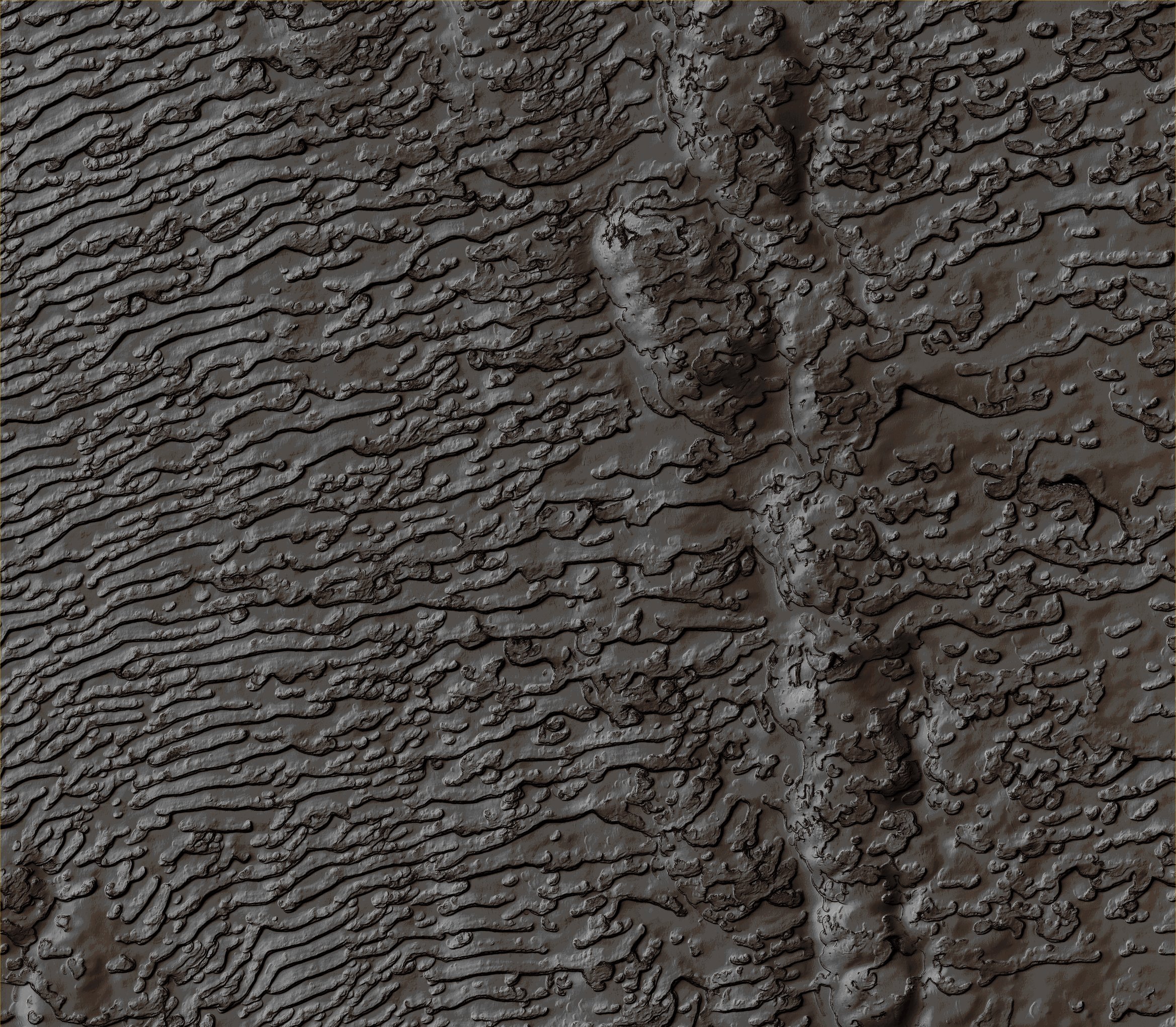
Credits: NASA/JPL/University of Arizona - Credits for the additional process. and color.: Dr Paolo C. Fienga/Lunar Explorer Italia/IPF
|
This NASA - Mars Reconnaissance Orbiter HiRISE image shows us a small portion of Mars' South Polar Residual Ice Cap. As a matter of fact, and like Earth, even Mars has high concentrations of Water Ice at both Poles. However, since Mars is way much colder than our Home Planet, the Seasonal Ice that deposits at very high latitudes (such as above + or -80° North Lat.) during the long and dark Martian Winter - and then gets removed during Springtime - is actually Carbon Dioxide (CO2) Ice. Around the South Pole of Mars there are whole areas covered by this CO2 Ice which do not disappear at every Spring, but rather survive, Winter after Winter. This Region of persistent Carbon Dioxide Ice is called "South Polar Residual Cap", and is what we are looking at in this NASA - Mars Reconnaissance Orbiter HiRISE image. Relatively high-standing smooth material is broken up by Semi-circular Depressions and Linear, branching Troughs that make a pattern resembling the one of a human fingerprint. We actually know, now, that these high-standing areas are several meters of CO2 Ice thick. The Depressions and Troughs are thought to be caused by the removal of Carbon Dioxide Ice by way of Sublimation (meaning the change of a material from a solid stae directly to gas). HiRISE is observing this CO2 Terrain in order to try to determine how these patterns develop and how fast the aforementioned Depressions and Troughs grow. While the South Polar Residual Cap (as a whole) is always present, there are anyway many changes which take place within it every year. Today, thanks to the high resolution of the NASA - Mars Reconnaissance Orbiter HiRISE images, Scientists from all over the World are trying and intend to measure the amount of expansion and/or contraction of both these Depressions and Troughs over a period of several Martian Years. In fact, if we know (and we do!) the amount of Carbon Dioxide that, in time, first deposits and then gets removed (better yet: sublimates) from the South Polar Terrain, then we will be able to get a relatively accurate idea of the Atmospheric, Weather, and Climate conditions of Mars over the course of time. In addition to this, if we keep looking for the areas where the CO2 Ice mostly deposits, we could really come to understand (of course once we shall have monitored these Regions and Features for a period, as we said above, of several Martian Years) if there is any net loss - or, instead, a net accumulation - of such a CO2 Ice over time. And this observation (and calculation) alone would also be a great indicator of whether Mars' Climate is really in the process of changing or not. Mars Local Time: 18:09 (Middle Afternoon) This frame has been colorized in Absolute Natural Colors by (such as the colors that a human eye would actually perceive if someone were onboard the NASA - Mars Reconnaissance Orbiter and then looked down, towards the Surface of the Mars), by using an original technique created - and, in time, dramatically improved - by the Lunar Explorer Italia Team.
|
News visualized: 817 times